
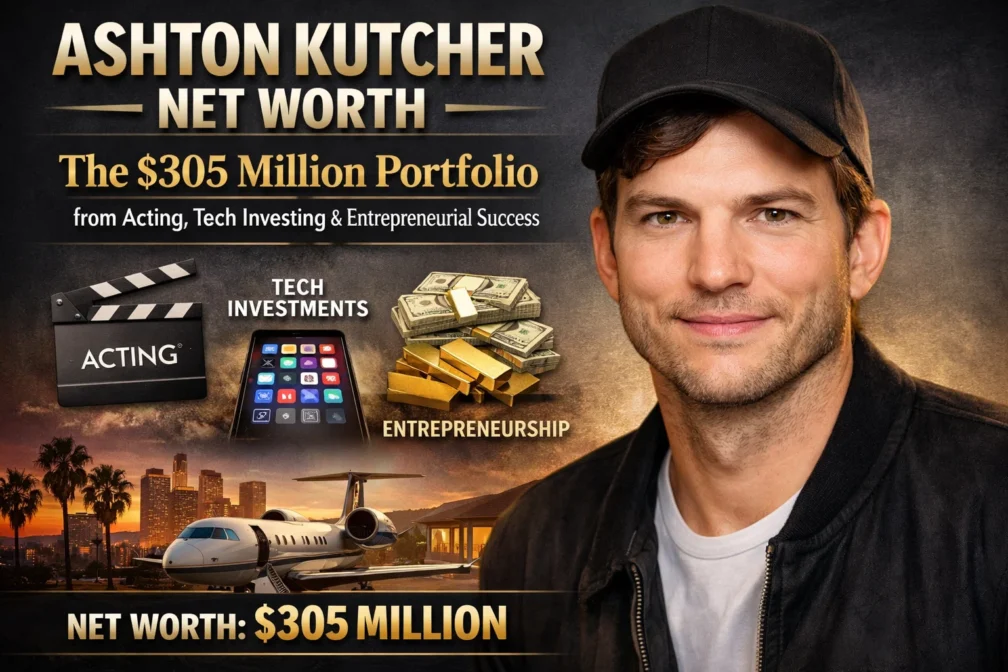

Ashton Kutcher Net Worth: Ashton Kutcher’s name conjures immediate images: the lovably dim-witted Michael Kelso from That ’70s Show, the charming heartthrob in a series of Hollywood rom-coms, or perhaps the tech-savvy entrepreneur on the hunt for the next unicorn. Yet, to define him by any single role is to miss the profound narrative of a man who strategically engineered one of the most compelling financial transformations in modern celebrity. His journey from a biochem university dropout in Iowa to a powerhouse investor with a staggering portfolio is a masterclass in strategic diversification and foresight.
While many celebrities leverage fame for endorsements, Kutcher leveraged his platform, curiosity, and capital to build genuine, lasting wealth in the technology sector. This deep dive into Ashton Kutcher’s net worth reveals a complex financial architecture far surpassing the typical earnings of an A-list actor. It’s a story of calculated risks, an innate understanding of the digital future, and an evolving personal brand that seamlessly bridges entertainment and Silicon Valley. The figure, often estimated at a robust $305 million, is not a static number but a testament to a dynamic, ongoing strategy of wealth creation.
From Iowa Cornfields to Hollywood Hills
Ashton Kutcher’s early life in Homestead, Iowa, offered few hints of the global fame and financial acumen to come. Born Christopher Ashton Kutcher, he initially pursued a biochemical engineering degree at the University of Iowa, driven by a practical mindset. However, fate intervened when he won a “Fresh Faces of Iowa” modeling contest, which led him to New York and eventually to Los Angeles. His big break came with the iconic role of Michael Kelso on That ’70s Show, a character that cemented his place in pop culture and provided the foundational capital for his future ventures. The show’s syndication rights continue to provide a valuable, passive revenue stream, forming the bedrock upon which he built his empire.
This initial foray into acting was followed by leading roles in films like Dude, Where’s My Car?, Just Married, and The Butterfly Effect. While these projects varied in critical reception, they collectively boosted his marketability and earning power. More importantly, his role as Walden Schmidt on Two and a Half Men reportedly earned him over $700,000 per episode, translating to tens of millions for the series’ final seasons. This phase of his career was crucial, as it generated the substantial liquid capital required for high-stakes investment. It was during this peak of Hollywood success that Kutcher began to look beyond the soundstage, recognizing that true, scalable wealth was being built not in studios, but in Silicon Valley garages and startup incubators.
The Pivotal Shift: An Investor is Born
The turning point in Kutner’s financial trajectory wasn’t a singular investment, but a shift in identity. Intrigued by the emerging social web, he began angel investing in the late 2000s, moving far beyond the typical celebrity endorsement deal. He immersed himself in the tech ecosystem, studying trends, meeting founders, and leveraging his massive social media following he was the first user to reach 1 million followers on Twitter as a strategic asset. This wasn’t dabbling; it was a deliberate career pivot. He co-founded a venture capital firm, A-Grade Investments, with talent manager Guy Oseary and billionaire Ron Burkle, formalizing his approach and pooling resources and expertise to chase larger opportunities.
This strategic shift marked the moment when Ashton Kutcher’s net worth transitioned from being primarily salary-dependent to being equity-driven. He famously stated, “I don’t invest in trends. I invest in people and solutions.” This philosophy guided his early bets. He spent countless hours with entrepreneurs, assessing not just their business models but their character and vision. This hands-on, founder-focused approach allowed him to identify opportunities that traditional VCs, often bound by rigid metrics, might have overlooked. It was this unique blend of celebrity access, genuine curiosity, and analytical rigor that positioned him to capitalize on the defining technological wave of the 2010s.
The Sound Investments: A-Grade’s Home Runs
The success of Kutcher’s investment strategy is most vividly illustrated by the landmark deals executed through A-Grade. The fund’s early portfolio reads like a hall of fame for tech unicorns. Their investment in Skype, made just before its $8.5 billion acquisition by Microsoft, delivered a staggering return rumored to be nearly fourfold their initial capital. This early win validated Kutcher’s thesis and provided further fuel for future investments. It demonstrated that his team could compete at the highest levels of venture capital, securing access to pre-IPO deals that were typically reserved for institutional giants.
However, the crowning jewel of this era, and perhaps the single most impactful investment on Ashton Kutcher’s net worth, was an early bet on a then-nascent accommodation-sharing platform. A-Grade invested $500,000 in Airbnb’s seed round in 2010. As the company grew into a global behemoth with a valuation exceeding $100 billion, that initial stake ballooned into an estimated $90-$100 million windfall. Similarly, a prescient investment in the transportation disruptor Uber, though a smaller stake than Airbnb, contributed tens of millions to his portfolio. These weren’t just lucky guesses; they were convictions in transformative business models that redefined entire industries, and Kutcher’s ability to spot and back them early is the core driver behind his financial stature.
Building a Legacy Firm: Sound Ventures
Following the monumental success of A-Grade, Kutcher and Oseary evolved their strategy by launching Sound Ventures in 2015. This new firm represented a maturation of their approach, moving from a smaller angel fund to a more institutional, thematic venture capital firm. With a dedicated fund structure and a broader mandate, Sound Ventures allowed them to write larger checks and take a more active role in guiding portfolio companies. The firm focuses on sectors like artificial intelligence, frontier tech, and fintech, aiming to identify the next generation of market leaders. This structure systematizes their investment process, aiming to replicate their earlier successes at scale.
Sound Ventures’ portfolio is a who’s who of modern tech, including companies like Spotify, Robinhood, and Affirm. The firm manages over $1 billion in assets, and its performance directly correlates with the growth of Kutcher’s personal fortune. By institutionalizing his investment activities, Kutcher ensured that his wealth generation was no longer tied to sporadic, individual bets but to a sustainable, scalable business model. The firm’s success cements his status not as a celebrity dabbler, but as a serious, respected figure in the venture capital community. This professionalization is key to understanding the durability and future trajectory of his financial empire.
Acting and Production: The Consistent Cash Flow
While his investment prowess garners significant attention, it is critical not to underestimate the ongoing contribution of Kutcher’s entertainment career to his overall financial health. His acting roles, particularly his high-salaried tenure on Two and a Half Men and later the lead role in the Netflix series The Ranch, provide a steady, high-volume income stream. This “guaranteed” capital is vital, as it offers financial stability and the freedom to make long-term, illiquid venture investments without pressure for immediate returns. It acts as a financial runway, allowing his riskier tech bets the time they need to mature.
Beyond acting, his production company, Katalyst Films, and various hosting and producing gigs add further layers to his entertainment revenue. He served as the host and producer of the popular television series Punk’d and has been involved in numerous other projects. These endeavors leverage his industry knowledge and brand equity within Hollywood, creating a diversified income stream within the entertainment vertical itself. This consistent cash flow from familiar territory effectively bankrolls his forays into the less predictable world of tech startups, creating a powerful symbiotic relationship between his two professional worlds.

Real Estate and Tangible Assets
Like many high-net-worth individuals, a portion of Kutcher’s wealth is allocated to tangible assets, with real estate being a prominent component. His property portfolio reflects a blend of personal enjoyment and shrewd investment. He and his wife, actress Mila Kunis, have bought and sold several high-value homes in the Los Angeles area. For instance, they purchased a property in Beverly Hills for over $10 million, later listing it for a significant profit. This activity shows an understanding of the luxury real estate market as both a lifestyle choice and a capital appreciation strategy.
His assets extend beyond residential property. While less publicized, it is reasonable to assume his portfolio includes other standard investments for the ultra-wealthy: art, collectibles, and possibly stakes in private equity outside of tech. These assets provide diversification, acting as a hedge against the volatility inherent in both the stock market and the high-risk venture capital world. They represent the “store of value” portion of his net worth, preserving capital in physical or traditionally appreciating forms. This balanced approach to asset allocation underscores a sophisticated, holistic view of wealth management.
Philanthropy and Social Impact
Kutcher’s financial narrative is incomplete without acknowledging his substantial commitment to philanthropy. He co-founded Thorn: Digital Defenders in 2012 with then-wife Demi Moore, an organization that builds technology to combat child sexual exploitation and trafficking. Thorn’s software, like Spotlight, is used by law enforcement agencies worldwide and has been instrumental in identifying victims and perpetrators. For Kutcher, this work is a profound mission, and he has testified before Congress on the issue, leveraging his celebrity to drive legislative and technological change.
This philanthropic work, while a moral imperative, also influences his investment philosophy. He is drawn to technology that can scale positive social impact, often blurring the lines between his for-profit and non-profit endeavors. The skills he hones in evaluating tech startups assessing teams, scalability, and product-market fit are directly applied to Thorn’s mission. This integration suggests that for Kutcher, wealth is not merely a scorecard but a tool for enabling meaningful change. It adds a dimension of purpose to his financial success, shaping how he allocates not just his capital, but his time and influential platform.
Market Context: Celebrity vs. Investor Wealth
To fully appreciate the scale of Kutcher’s financial achievement, it is instructive to place his net worth in context. The typical path for a major television star is one of high salaries, endorsement deals, and perhaps a production company. This often leads to wealth in the tens of millions. Kutcher has transcended that model entirely. By comparison, his Two and a Half Men co-star Jon Cryer, while successful, has an estimated net worth around $70 million. Kutcher’s fortune, powered by equity, is multiples larger. He operates in a financial league closer to founders and early employees of major tech companies than to his Hollywood peers.
This comparison highlights the transformative power of equity ownership versus earned income. A salary, no matter how high, is linear. Equity ownership in a hyper-growth company is exponential. Kutcher’s genius was in using his linear income (acting salaries) to purchase exponential potential (startup equity). The following table illustrates the dramatic impact of his two most famous investments compared to his entertainment earnings:
Table: The Equity Advantage: How Ashton Kutcher’s Investments Outpaced His Acting Income
| Wealth Source | Capital Deployed / Effort | Estimated Financial Return | Wealth Characteristic |
|---|---|---|---|
| Role on Two and a Half Men | High time commitment over 4 seasons; performance-based salary. | ~$20-30 million (total salary) | Linear & Active: Direct exchange of time for money. High immediate cash flow, but stops when work stops. |
| Early Investment in Airbnb | $500,000 capital + due diligence & networking. | $90-100 million+ (upon IPO & beyond) | Exponential & Passive: Front-loaded work/capital. Return is a multiple of initial input, creating lasting, scalable asset value. |
| Early Investment in Uber | Undisclosed capital (likely similar scale). | $30-60 million+ (estimates vary) | Exponential & Passive: Again, a high-multiple return on invested capital, generating wealth orders of magnitude larger than the initial stake. |
The table starkly demonstrates why Kutcher’s financial outcome is so different from that of a pure actor. The venture investments, while riskier, created asset value that dwarfs even the most lucrative acting contracts, fundamentally altering the ceiling of his Ashton Kutcher net worth.
Common Misconceptions and Clarifications
A common misconception is that Kutcher’s investment success was merely a function of his celebrity, allowing him “adviser” roles or easy access to hot deals. While his fame certainly opened doors initially, it did not guarantee success. Many celebrities have lost fortunes on bad tech bets. His sustained track record is attributable to rigorous work. He is known for deep due diligence, often working directly with engineering teams to understand product architecture. As a partner at Sound Ventures noted, “He’s one of the hardest-working people in the room. He reads every line of the term sheet and challenges every assumption in the business plan.” This dispels the myth of the passive celebrity investor.
Another misunderstanding is viewing his wealth as a single, lucky break. The narrative often focuses solely on Airbnb and Uber. While these are home runs, they represent peaks in a much broader and consistently constructed portfolio. Sound Ventures has made over 100 investments. For every Airbnb, there are numerous companies that provided modest returns or failed. His overall net worth is the product of a portfolio strategy where a small number of outsized winners compensate for many losses the fundamental law of venture capital. His skill lies in having a high enough “batting average” and the conviction to invest heavily in the deals he believes in most.
The Future Trajectory of His Fortune
Looking forward, the growth trajectory of Ashton Kutcher’s net worth is inextricably linked to the performance of Sound Ventures’ funds and the technology market cycle. With hundreds of millions of dollars deployed across a new generation of startups in AI, blockchain, and biotechnology, his financial future hinges on identifying the next paradigm shift. The firm’s recent focus suggests bets on the infrastructure of the future, from quantum computing to sustainable energy tech. His ability to pivot and identify value in these complex, emerging sectors will be the ultimate test of his investment acumen.
Furthermore, his personal brand continues to evolve. He may take on more roles as a public intellectual on technology and its societal impact, or increase his involvement in policy through his philanthropic work. Any new ventures or media projects he launches will add incremental value. However, the core engine remains Sound Ventures. As long as the firm continues to secure access to top-tier deal flow and generate venture-scale returns, Kutcher’s wealth is positioned not just to be maintained, but to compound significantly over the coming decades, potentially pushing his net worth toward the billion-dollar mark.
Conclusion
The story of Ashton Kutcher’s financial ascent is a modern parable of strategic reinvention. It began with charismatic talent and Hollywood opportunity but was cemented by intellectual curiosity, relentless work ethic, and a visionary embrace of technological change. His estimated $305 million net worth is not a lucky lottery ticket but the direct result of a deliberate, two-pronged strategy: using the substantial, reliable cash flow from a top-tier acting career to fund high-risk, high-reward investments in disruptive technology. He mastered the art of converting fame into access, access into insight, and insight into equity.
More than just an actor or an investor, Kutcher engineered a personal ecosystem where each facet of his career supports and amplifies the others. His journey offers a powerful blueprint: that the most profound wealth is built not just from earning, but from owning owning pieces of the future. As he continues to navigate the frontiers of technology with Sound Ventures, his financial legacy is still being written, serving as a compelling case study in 21st-century wealth creation.
Frequently Asked Questions (FAQ)
What is the primary source of Ashton Kutcher’s net worth?
While his successful acting career provided the initial capital, the primary and largest source of Ashton Kutcher’s net worth is his venture capital investments. The exponential returns from early stakes in companies like Airbnb and Uber, managed through his firms A-Grade Investments and Sound Ventures, far surpass his lifetime earnings from Hollywood and form the cornerstone of his estimated $305 million fortune.
How did Ashton Kutcher get into tech investing?
Kutcher’s entry into tech investing was driven by genuine personal interest in the emerging social web of the late 2000s. He began making personal angel investments, leveraging his early-adopter status on platforms like Twitter. He formalized this passion by co-founding A-Grade Investments with Guy Oseary and Ron Burkle, which allowed him to pool resources and expertise to pursue larger, more strategic opportunities in the startup world.
Is Ashton Kutcher a billionaire?
No, Ashton Kutcher is not a billionaire. Most credible financial analyses estimate his current net worth to be approximately $305 million. While this is an extraordinary sum that places him far above most celebrities, it is below the billion-dollar threshold. His continued work with Sound Ventures, however, positions him for future growth that could potentially approach that level depending on the performance of his investment portfolio.
What are some of Ashton Kutcher’s most successful investments?
His most successful investments are legendary in venture capital circles. The standout is his early $500,000 seed investment in Airbnb, now worth an estimated $90-100 million. His investment in Uber also yielded returns in the tens of millions. Other notable successes include early bets on Skype (before its Microsoft acquisition), Spotify, and Warby Parker, all contributing significantly to his overall financial portfolio.
How does Ashton Kutcher’s net worth compare to other celebrity investors?
Kutcher’s net worth and investment track record place him in a unique, top-tier category among celebrity investors. While others like Jessica Alba (The Honest Company) or George Clooney (Casamigos Tequila) have had spectacular exits, Kutcher’s success is broader and more systematic through a diversified VC fund. He is often compared to figures like Jared Leto, who also invests in tech, but Kutcher’s earlier start, larger fund size, and landmark exits give him a distinct edge and a higher estimated net worth.