
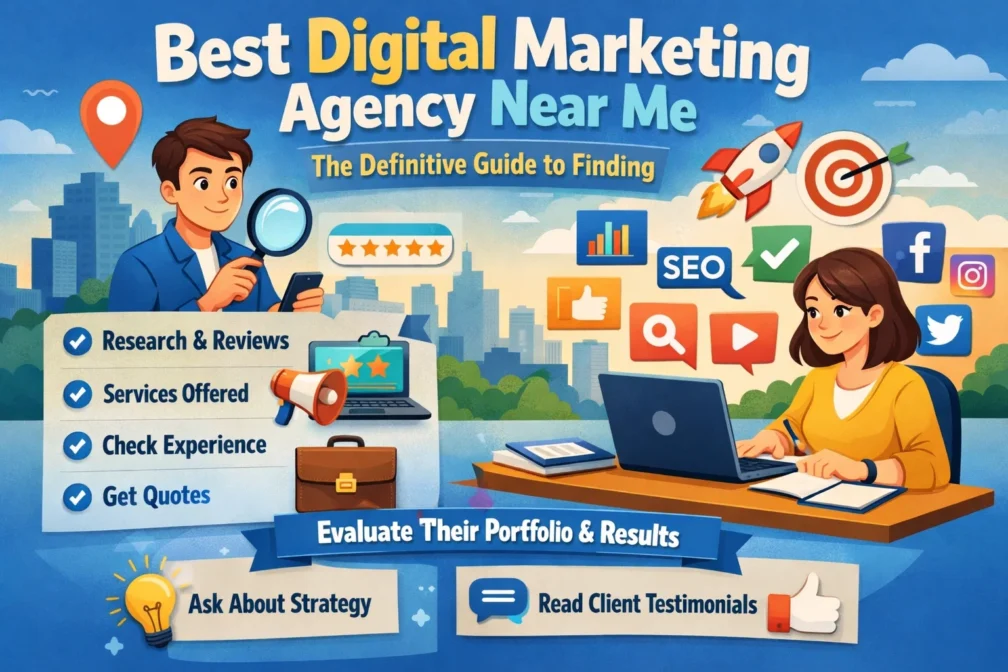

You’ve typed “best digital marketing agency near me” into the search bar. You’re not just looking for a service provider; you’re seeking a transformative partner for your business. You need a team that understands your local market, can navigate the intricate digital landscape, and, most importantly, is accountable for delivering real growth that you can see in your community and on your balance sheet. This search is critical. The agency you choose becomes an extension of your team, a steward of your brand’s online presence, and a key driver of your future revenue.
Yet, the results can be overwhelming. Countless agencies promise the world, using jargon-filled pitches and guaranteed rankings. How do you cut through the noise to find a partner that offers not just tactics, but strategic wisdom? This comprehensive guide is designed to be your ultimate resource. We will move beyond simple directories and reviews to explore the core philosophies, operational frameworks, and measurable outcomes that separate true market leaders from the rest. By understanding what truly makes an agency effective, you empower yourself to make a choice that aligns with your specific business goals, culture, and vision for the future.
Understanding What “Best” Truly Means in Digital Marketing
The term “best” is subjective and dangerously overused. In the context of a digital marketing agency, it should never be a standalone claim. The best digital marketing agency for a Fortune 500 company will be a terrible fit for a family-owned restaurant launching its first website. True excellence is contextual, defined by a perfect alignment between an agency’s proven strengths and a client’s unique challenges, industry, scale, and ambitions. It’s less about a trophy case of awards and more about a documented history of solving problems similar to yours.
Therefore, your search for the best digital marketing agency near me must begin with introspection. Before evaluating any agency, you must crystallize your own definition of success. Is it increasing local foot traffic by twenty percent? Is it dominating a niche B2B sector with high-value leads? Is it building a nationally recognized e-commerce brand? Your specific objectives become the filter through which all agency capabilities, case studies, and promises must be viewed. An agency that is the best at viral TikTok campaigns may be the wrong partner if your goal is long-term organic authority in a complex, technical field.
The Irreplaceable Value of a Local Partner
In an increasingly virtual world, the strategic advantage of a local partner is often underestimated. A genuine “near me” agency offers more than just the convenience of a short drive for a meeting. It provides an innate, ground-level understanding of your regional market dynamics, customer psychographics, and competitive landscape. They know which local influencers move the needle, which community events matter, and how regional search trends differ from national ones. This cultural and commercial intimacy is impossible to replicate by a distant agency working from a spreadsheet.
This local expertise translates directly into more effective and efficient campaigns. A nearby agency can quickly adapt strategies based on real-world observations, build partnerships with other local businesses, and create hyper-localized content that resonates authentically. When an agency team shops at the same stores, navigates the same traffic, and understands the local economy’s nuances, their marketing recommendations carry a depth of insight that generic strategies lack. For businesses where community presence is key, this local lens isn’t just an add-on; it’s the core of a successful strategy.
Core Services of a Modern Full-Service Agency
The digital ecosystem is interconnected, and a modern, top-tier agency operates with a holistic, integrated mindset. While specialization exists, the best digital marketing agency near you will offer a synergistic suite of core services designed to work in concert. Search Engine Optimization (SEO) builds lasting visibility, Pay-Per-Click (PPC) advertising captures immediate intent, and social media marketing fosters community and brand loyalty. These are not isolated channels but threads in a larger narrative.
Beyond these, content marketing establishes authority and educates your audience, email marketing nurtures leads into customers, and web design & development ensures every interaction is seamless and conversion-optimized. The magic happens not in the execution of any single service, but in the strategic orchestration of all of them. A social media campaign should drive traffic to a SEO-optimized blog post, which captures an email lead, who is then nurtured by a automated email sequence. Understanding this full spectrum is key to evaluating an agency’s capacity to manage your entire digital presence.
Strategic Alignment: Defining Your Goals and Budget
A successful agency-client relationship is built on a foundation of absolute clarity. The first step is for you to articulate your business goals with as much specificity as possible. Vague desires like “get more leads” or “be more visible” are impossible to measure and difficult to strategize against. Instead, frame goals as SMART objectives: Specific, Measurable, Achievable, Relevant, and Time-bound. For example, “Increase qualified lead volume from the website by thirty percent within the next two fiscal quarters” provides a clear target for both you and your agency.
With goals defined, you can establish a realistic budget that reflects the investment required to achieve them. This is a crucial conversation to have upfront. A professional agency will discuss budget transparently, explaining how resources will be allocated across different channels and strategies. They should be able to articulate the expected return on investment (ROI) and key performance indicators (KPIs) that will track progress. This alignment ensures that both parties are working toward the same finish line with a shared understanding of the resources required to get there.
The Evaluation Framework: What to Look For
When narrowing down your list of potential partners, a structured evaluation framework is essential. Look beyond the sales pitch and examine tangible evidence of capability and cultural fit. First, scrutinize their portfolio and case studies. Do they have demonstrable success in your industry or with businesses of your size? Look for detailed breakdowns that explain the challenge, the strategy implemented, and the quantifiable results achieved. Case studies should tell a story of problem-solving, not just boast about metrics.
Second, assess their team and communication style. Who will be your day-to-day contacts? What is the experience level of the strategists and specialists who will handle your account? During initial consultations, gauge their curiosity about your business. Are they asking deep, probing questions, or are they immediately jumping to a pre-packaged solution? The right agency will act as a diagnostic partner first, seeking to understand the root causes of your challenges before prescribing a cure. This consultative approach is a hallmark of a true partner.
Critical Questions to Ask During Consultations
Your first meetings with a prospective agency are investigative interviews. Come prepared with questions that uncover their operational philosophy and reliability. Inquire about their reporting processes: How often will you receive reports, what metrics will they include, and how do they contextualize data into actionable insights? Ask about their tools and technologies for tracking, analytics, and competitive analysis. A sophisticated agency leverages a stack of professional tools to inform their decisions and prove their value.
Probe into their approach to challenges and adaptation. The digital landscape changes daily; how do they stay ahead of algorithm updates and trend shifts? Can they provide an example of a time a strategy wasn’t working and how they pivoted? Finally, discuss the practicalities: contract terms, onboarding processes, and key performance indicator (KPI) setting. Understanding these details upfront prevents misunderstandings later and reveals how the agency views the client relationship—is it a transactional service agreement or a collaborative partnership aimed at shared growth?
Red Flags and Common Industry Misconceptions
Awareness of common pitfalls can save you significant time, money, and frustration. One major red flag is any agency that guarantees specific ranking positions (e.g., “#1 on Google”) or promises unrealistic, overnight results. Ethical SEO and sustainable growth are gradual processes influenced by countless volatile factors. Such guarantees are a clear sign of outdated or black-hat tactics that can ultimately harm your site. Another warning sign is a lack of transparency. If an agency is vague about its strategies, reluctant to provide detailed reporting, or uses opaque jargon to avoid straight answers, proceed with extreme caution.
A prevalent misconception is that the largest, most expensive agency is inherently the best. Often, a mid-size or specialized local firm can provide more attentive service, deeper senior-level involvement, and greater flexibility. Conversely, the cheapest option is rarely a bargain; you often pay for inexperience, inferior tools, or outsourced labor that lacks strategic oversight. The goal is to find the optimal balance of expertise, service, and value—a partner whose capabilities are commensurate with your needs and whose culture fosters a productive, trusting relationship.
The Role of Data, Analytics, and Transparent Reporting
In digital marketing, intuition must be guided by evidence. The best digital marketing agency near me will be obsessive about data, using it as the compass for every decision. They should have mastery of platforms like Google Analytics 4, Google Search Console, and advanced business intelligence tools to track user behavior, campaign performance, and attribution. Data tells the story of your customer’s journey, revealing what’s working, what’s not, and where opportunities for optimization lie. Without robust analytics, you’re marketing in the dark.
Transparency in reporting is the non-negotiable companion to data expertise. You should receive regular, clear reports that don’t just list numbers but interpret them. A great report answers the “so what?” question: “Impressions are up 50%—so what does that mean for lead quality?” or “Click-through rate dropped—so what change did we test, and what did we learn?” This level of insight transforms data from a vanity metric into a strategic asset. It ensures you are always informed, aligned, and able to see the direct connection between marketing activities and business outcomes.
The Onboarding Process and Ongoing Collaboration
The transition from signing a contract to executing a strategy is a critical phase that sets the tone for the entire partnership. A thorough, structured onboarding process is a strong indicator of an agency’s professionalism and commitment. This should include a deep-dive discovery session, comprehensive audits of your existing assets (website, social profiles, past campaigns), detailed persona development, competitive analysis, and the joint creation of a first-phase strategic roadmap. This foundational work ensures everyone starts from the same page.
Ongoing collaboration should be proactive, regular, and focused. Establish clear communication protocols: weekly or bi-weekly tactical calls, monthly strategic reviews, and quarterly business reviews to assess high-level progress toward goals. The agency should act as an extension of your team, bringing ideas, insights, and recommendations to the table. The most successful relationships are characterized by a true partnership dynamic, where both client and agency feel invested in the journey and empowered to contribute to the strategy’s evolution based on real-world results and market feedback.
Comparing Agency Models: A Structured Insight
Not all agencies are structured the same way. Understanding these fundamental models will help you identify which type is the best fit for your operational style and needs. The table below breaks down the key characteristics of the three primary agency models prevalent today.
| Agency Model | Core Characteristics | Typical Client Fit | Key Considerations |
|---|---|---|---|
| Full-Service Integrated | Offers a complete suite of services (SEO, PPC, Social, Content, Web Dev) under one roof. Strategy is unified and channels are managed cohesively. | Businesses seeking a single point of accountability for their entire digital presence. Ideal for those who want integrated strategy and simplified management. | Ensure the agency has true depth in all service areas, not just a thin veneer. Ask about how teams collaborate across disciplines. |
| Specialized Boutique | Focuses deeply on one or two core disciplines (e.g., only SEO & Content, or only PPC). Often founded by niche experts. | Businesses with a specific, well-defined need or those who prefer to work with best-in-class specialists for each channel separately. | Requires the client to manage multiple agency relationships. Ensure their specialization aligns perfectly with your top priority. |
| Platform-Specific Expert | Masters a single platform or ecosystem (e.g., a “Google Premier Partner” agency, or an elite “Facebook Marketing Partner”). | Businesses whose strategy is heavily dependent on one channel’s performance or who need advanced, platform-specific innovation. | Can be excellent for channel-specific expertise but may lack the broader, cross-channel strategic perspective needed for holistic growth. |
The Importance of Cultural Fit and Shared Values
While metrics and strategies are paramount, the human element of the partnership cannot be ignored. The best digital marketing agency for your business will be one whose company culture and values resonate with your own. Do they champion transparency, integrity, and continuous learning? Are they proactive and entrepreneurial, or reactive and rigid? The agency’s team will be representing your brand in the digital sphere; their creative tone, problem-solving approach, and ethical standards should feel like a natural extension of your own team’s ethos.
A strong cultural fit fosters open communication, mutual respect, and a resilient partnership that can withstand the inevitable challenges of a dynamic market. When values align, difficult conversations about pivoting strategies or reallocating budget become collaborative problem-solving sessions rather than contentious negotiations. This synergy often leads to more innovative ideas, as both parties feel psychologically safe to propose creative, even unconventional, solutions. In the long run, this intangible alignment can be the difference between a merely functional vendor relationship and a transformative business alliance.
Measuring Success Beyond Clicks and Likes
Ultimately, the value of a digital marketing agency must be judged by its impact on your business’s fundamental health. While intermediate metrics like clicks, impressions, and social engagement are important indicators of activity, they are not the final measure of success. The true north for any campaign should be its contribution to meaningful business outcomes: revenue growth, customer acquisition cost (CAC), lifetime value (LTV), lead quality, and market share expansion. A sophisticated agency always maps its tactical work back to these bottom-line objectives.
This requires a focus on attribution and ROI modeling. How many new customers last quarter started their journey with an organic search click that the agency drove? What was the total pipeline value generated from a specific content campaign? The best digital marketing agency near you will build tracking systems to connect marketing efforts to sales results, even in complex B2B environments with long sales cycles. They will work with you to define what a “qualified lead” truly means for your sales team and ensure their efforts are concentrated on attracting and converting that ideal profile, not just driving generic traffic.
Navigating Contracts and Building a Long-Term Partnership
The formal agreement with your agency is the blueprint for the relationship. Read it carefully. Pay close attention to the scope of work, which should clearly outline deliverables, timelines, and responsibilities. Understand the pricing model—is it retainer-based, project-based, or performance-linked? Clarify the terms for termination, ownership of created assets (like website code or content), and how additional work outside the scope is handled. A fair contract protects both parties and sets clear expectations.
“A contract isn’t just a legal document; it’s the first draft of your partnership’s communication style. Clarity and fairness at this stage build the trust needed for long-term success,” notes a veteran agency owner.
View this agreement as the start of a long-term journey, not a one-time transaction. The most significant marketing results compound over time. SEO gains momentum, brand awareness builds gradually, and customer loyalty deepens. Choose an agency you believe can be a steadfast partner for years, evolving their strategies as your business scales and the market shifts. This long-term perspective encourages investment in foundational assets and big-picture thinking, moving beyond short-term tactical wins to build enduring digital equity for your brand.
Conclusion
Your search for the best digital marketing agency near me is a strategic investment in your company’s future. It is a decision that goes far beyond hiring a vendor to manage ads or a website. You are selecting a growth partner, a strategic advisor, and an extension of your team tasked with navigating the complex digital frontier on your behalf. The journey requires diligence, introspection, and a focus on the factors that truly matter: strategic alignment, proven expertise, cultural fit, and an unwavering commitment to your business outcomes.
By leveraging the framework and insights in this guide, you can move forward with confidence. You are now equipped to ask the right questions, interpret the signals, and identify a partner who will not just execute tasks, but will collaborate with you to build a resilient, data-driven, and highly effective digital presence. Remember, the goal is not to find the agency that is best in abstract, but the one that is unequivocally the best digital marketing agency near me for your unique vision, challenges, and aspirations. The right partnership will unlock potential, drive measurable growth, and become a cornerstone of your business’s success story.
Frequently Asked Questions
What is the average cost of hiring a digital marketing agency?
Costs vary dramatically based on agency size, location, service scope, and your business’s needs. A local boutique agency might offer focused packages starting from a few thousand dollars per month, while a full-service regional agency’s retainers often range from $5,000 to $20,000+ monthly. The key is to focus on the expected ROI. When discussing cost with a potential best digital marketing agency near me, ask them to model how the investment translates into leads, sales, or other tangible business growth.
How long does it take to see results from digital marketing efforts?
This depends entirely on the strategies employed. Paid advertising (PPC) can drive traffic and leads within days. Search Engine Optimization (SEO) is a longer-term investment, typically taking 4 to 6 months to see significant organic ranking improvements and sustained traffic growth. Social media and content marketing build influence and authority over months. A trustworthy agency will provide a realistic timeline during the onboarding process, setting expectations for both immediate and long-term milestones.
Can I handle my digital marketing in-house instead?
You can, but it requires significant investment in hiring a team of specialists (SEO, PPC, content, design), ongoing training, and expensive software tools. For many small to mid-size businesses, partnering with the best digital marketing agency near me is more cost-effective. It provides immediate access to a full team of experts, established processes, and advanced technology, freeing you to focus on running your core business while leveraging external expertise for growth.
What makes a local agency better than a national one?
A genuine local partner brings intrinsic knowledge of your market’s demographics, competitors, and cultural nuances. They offer easier, more frequent face-to-face collaboration and often provide more personalized service as you are a larger fish in a smaller pond. For businesses where community connection is vital, this local insight is invaluable. A national agency might offer broader resources but can lack the granular, on-the-ground understanding that drives highly targeted local campaigns.
How do I know if an agency’s strategies are ethical and sustainable?
Ask direct questions. Inquire about their approach to SEO link building (it should be about earning quality links, not buying them), their compliance with platform policies (like Google’s terms), and their focus on creating value for the end-user. Ethical agencies educate their clients, avoid “secret sauce” jargon, and prioritize long-term brand health over short-term tricks. Transparent reporting and a willingness to explain their methodologies in plain language are strong indicators of an ethical, sustainable partner.