
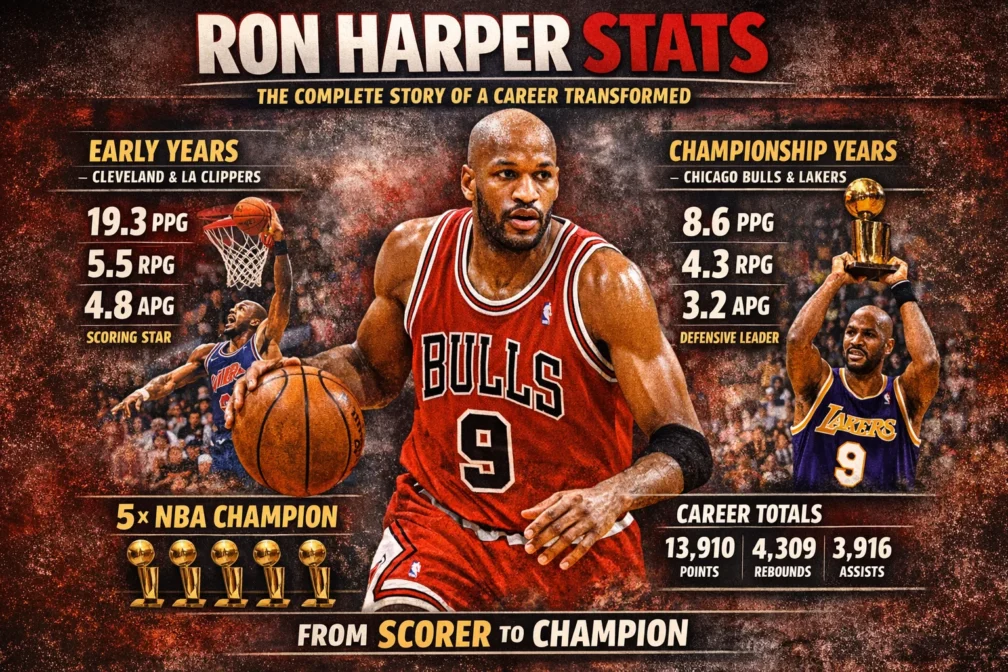

Ron Harper Stats;In the sprawling narrative of NBA history, certain players become synonymous with a single, glittering image. Michael Jordan is the ultimate winner, Larry Bird the consummate shooter, Magic Johnson the revolutionary passer. Then there are players like Ron Harper, whose career tells a richer, more complex story—a story best understood not by a single highlight, but through the full arc of his Ron Harper stats. To look at his career totals is to see a tale of two distinct basketball lives: the first as a high-flying, prolific scoring star burdened with carrying a franchise, and the second as a selfless, defensive-minded floor general who became an indispensable cog in the greatest dynasty of the modern era.
His statistics are a ledger of adaptation, sacrifice, and ultimate success. This deep dive goes beyond the box score to explore how Harper’s numbers reflect a profound basketball intelligence and a willingness to completely redefine his game for the pursuit of championships. We’ll unpack every phase, from his explosive entry in Cleveland to his pivotal role in Chicago and Los Angeles, revealing why his Ron Harper stats are a masterclass in career evolution.
The Cleveland Catalyst: Explosive Beginnings and Franchise Scorer
When the Cleveland Cavaliers selected Ron Harper seventh overall in the 1986 NBA Draft, they weren’t just getting a player; they were getting an event. Harper burst onto the scene with a breathtaking combination of size, athleticism, and scoring instinct rarely seen at the shooting guard position. His rookie season was an immediate declaration of stardom, averaging 22.9 points, 4.8 rebounds, 4.8 assists, and a league-leading 2.5 steals per game. These initial Ron Harper stats placed him in the Rookie of the Year conversation and signaled the arrival of a potential franchise cornerstone. He wasn’t just putting up empty numbers on a bad team; he was a dynamic, two-way force whose steal rate hinted at the defensive prowess that would later define his career’s second act.
Harper’s following years in Cleveland solidified his status as a premier scorer. In his second season, he upped his average to 21.9 points per game, and in his third, he posted a career-high 15.7 field goal attempts per contest. The narrative around Harper was clear: he was the go-to option, the engine of the Cavaliers’ offense alongside rising star Brad Daugherty. However, a deeper look at the Ron Harper stats from this era, such as his shooting percentages (often in the low-to-mid 40s) and turnover numbers, reveals the immense burden he carried. He was asked to create offense constantly against the opponent’s best defender, a role that, while prolific, was not fully efficient or sustainable for team success at the highest level.
The Clippers Interlude: Maintaining Production Amid Instability
Harper’s trade to the Los Angeles Clippers in 1989 was a seismic shift from a promising young core to one of the league’s most chaotic franchises. Yet, his individual production remained remarkably consistent, a testament to his innate scoring talent. In his first full season with the Clippers (1989-90), Harper averaged 23.0 points, 5.6 rebounds, 4.9 assists, and 2.1 steals, mirroring his Cleveland output almost exactly. For a player whose game was built on athleticism and transition play, maintaining such numbers in a disjointed environment highlighted his ability to generate offense independently. The Ron Harper stats from his Clippers tenure are a study in individual excellence amidst organizational turbulence.
However, this period also marked the beginning of physical challenges. A devastating knee injury during the 1990-91 season limited him to just 39 games and robbed him of a step of his legendary explosiveness. While he returned to post solid numbers—like the 20.1 points per game he averaged in the 1991-92 season—the style of his play began to subtly change. The highlight-reel dunks became less frequent, replaced by a more cerebral, ground-based game. This forced evolution, visible in a slight dip in his per-game averages and free-throw attempts, was a crucial, if painful, transition phase. It prepared him, unknowingly, for the radically different role that would define his legacy.
The Chicago Metamorphosis: Sacrifice and Strategic Reinvention
The 1994 free-agent signing of Ron Harper by the Chicago Bulls was met with widespread skepticism. Here was a player known for volume scoring joining a team built around the ultimate volume scorer, Michael Jordan, who was temporarily playing baseball. The Bulls, under General Manager Jerry Krause and Coach Phil Jackson, saw something else entirely. They saw a long, intelligent defender with point guard skills who could orchestrate an offense without dominating the ball. Harper’s mission was to reinvent himself, and the ensuing Ron Harper stats are the starkest evidence of professional sacrifice in modern NBA history. His scoring average plummeted from 20.1 points in his last Clippers season to 6.9 points in his first Bulls season.
This statistical nosedive was not a decline; it was a strategic retreat. Harper morphed into the Bulls’ defensive quarterback at the point of attack. His assignment night after night was to harass the opponent’s primary ball-handler, using his size (6’6″) to disrupt offenses before they could initiate. His offensive role was simplified to spotting up, making the extra pass, and cutting intelligently within the Triangle system. A quote from Phil Jackson perfectly encapsulates this transformation: “We didn’t need Ron to score 20 a night. We needed him to be our first line of defense, to be steady, and to make the right play. He mastered that role, and it made us complete.” Harper’s value became immeasurable by traditional box score Ron Harper stats, residing instead in defensive ratings, on/off court net ratings, and the sheer respect he commanded from opposing point guards.
The Defensive Anchor: Quantifying the Intangible Impact
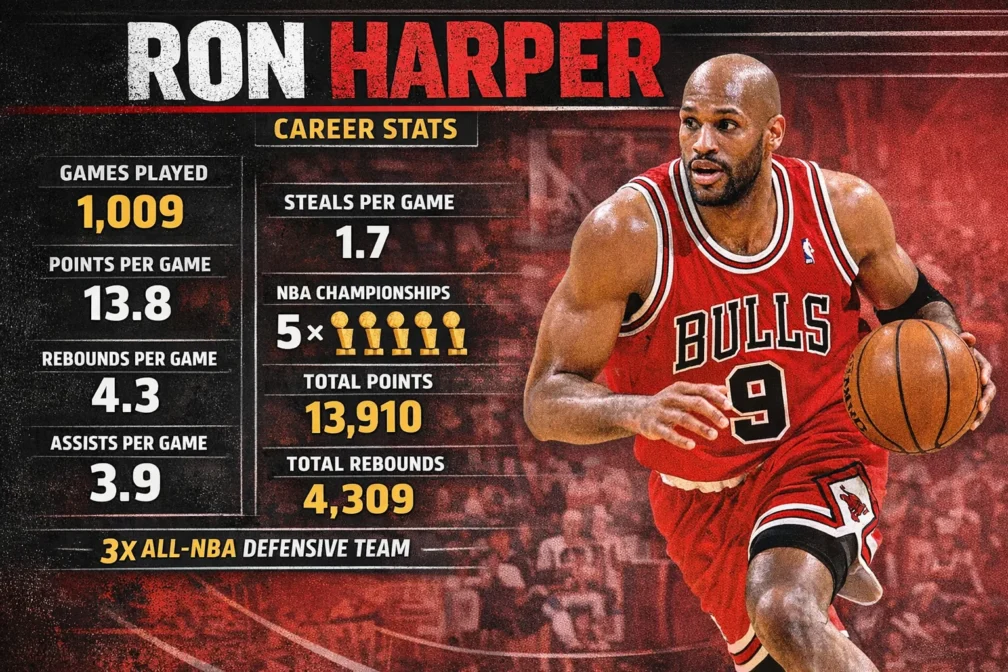
While steals are the primary defensive statistic, Harper’s impact in Chicago went far beyond that single column. His defensive role was about containment, pressure, and forcing opponents into bad decisions. He was tasked with navigating screens, fighting over picks, and using his length to contest shots without fouling. Analyzing advanced Ron Harper stats from this era, though limited compared to today’s tracking, shows his consistent presence on lineups with elite defensive ratings. He was the connective tissue between the Bulls’ defensive system and its execution, often setting the tone in the first quarter by physically wearing down his matchup.
His offensive statistics during the second three-peat, while modest, were deceptively efficient. He shot a respectable percentage from the field, often in the high 40s, because he took only high-quality shots within the flow of the offense. His assist-to-turnover ratio, a critical metric for a non-dominant ball-handler in a complex system, was consistently strong. Harper’s game log from the 1996 Finals against Seattle, for example, might show 6 points, 5 rebounds, and 4 assists, but his relentless hounding of Gary Payton was a cornerstone of the Bulls’ strategy. This ability to impact winning without filling the stat sheet is the purest evidence of his basketball maturity.
Championship Pedigree: The Ultimate Statistical Validation
The most important numbers on Ron Harper’s career stat sheet are undoubtedly 5 and 0—his five NBA championship rings and his zero Finals losses. This perfect record in the championship series is the ultimate validation of his career transformation. In the 1996, 1997, and 1998 Finals with the Bulls, his Ron Harper stats were the epitome of role-player excellence: timely steals, crucial offensive rebounds, and defensive stops. He started every game during those title runs, a clear signal of trust from Phil Jackson that his contributions, however subtle in the box score, were non-negotiable for team success.
His championship journey didn’t end in Chicago. After the Bulls’ dynasty dissolved, Harper followed Phil Jackson to the Los Angeles Lakers, bringing his veteran savvy and defensive mindset to a young team featuring Shaquille O’Neal and Kobe Bryant. At age 36 and 37, he started for the Lakers during their 2000 and 2001 championship seasons. His statistical output was minimal, but his presence was maximal. He provided stability, knew the intricacies of the Triangle Offense better than anyone except Jackson himself, and offered another layer of defensive toughness. These final two titles cemented his legacy as the ultimate role-playing champion, a player whose statistical evolution directly correlated with the highest team achievement.
Statistical Deep Dive: Career Averages vs. Championship Contributions
To truly appreciate the duality of Ron Harper’s career, one must place his overall averages side-by-side with his numbers during his championship seasons. This comparison reveals the dramatic shift in role and the conscious sacrifice of personal production for team glory. The table below provides a clear, at-a-glance view of this transformation.
| Statistical Category | Career Averages (1987-2001) | Averages During 5 Championship Seasons (CHI ’96-’98, LAL ’00-’01) |
|---|---|---|
| Points Per Game | 13.8 | 7.3 |
| Rebounds Per Game | 4.3 | 3.6 |
| Assists Per Game | 3.9 | 2.9 |
| Steals Per Game | 1.7 | 1.3 |
| Minutes Per Game | 33.0 | 25.8 |
| Field Goal % | 44.5% | 43.8% |
| Role & Context | Primary/Secondary Scoring Option, Focal Point of Offense | Defensive Specialist, Tertiary Ball-Handler, System Role Player |
This table crystallizes the narrative. The nearly 50% reduction in scoring and the drop in minutes aren’t signs of decline, but of reallocation. His energy was directed almost exclusively toward the defensive end and playing mistake-free, system-oriented basketball on offense. The consistency in field goal percentage, despite a lower volume of easier shots, indicates disciplined shot selection. These Ron Harper stats from his title years are the blueprint for a winning role player.
Legacy and Modern Comparison: The Proto-Two-Way Wing
In today’s positionless NBA, Ron Harper’s career arc feels prophetic. He entered the league as a scoring wing with defensive tools and left it as a defensive specialist with just enough offensive savvy. Modern fans might look at his career Ron Harper stats and see a player like Jrue Holiday or Marcus Smart—guards who can score in bursts when needed but whose primary value is derived from their ability to defend multiple positions, lead a defense vocally, and make intelligent plays without turning the ball over. Harper was a prototype of this mold, proving two decades ago that a player’s impact could radically shift while his value soared.
His legacy is a powerful lesson in basketball maturity. In an era obsessed with player empowerment and statistical accumulation, Harper’s story is a reminder that the greatest success often comes from subsuming one’s game to a larger system. His statistical decline was not a fall from grace, but an ascent to a different, more meaningful kind of stardom—the stardom of winning. When fans and analysts review Ron Harper stats, they should see not two separate careers, but one continuous journey of a player who possessed the rare wisdom to understand what his team needed at every stage, and the skill to deliver it.
Conclusion
The complete picture of Ron Harper’s career cannot be captured by glancing at his 13.8 points per game career scoring average. That single number obscures the thrilling 20-point-a-night scorer he was in Cleveland and Los Angeles, and it undervalues the transformative, championship-winning defender he became in Chicago and Los Angeles again. His Ron Harper stats are, in essence, a biography written in numbers—a record of explosive talent, resilient recovery from injury, and intentional, professional sacrifice. He mastered the art of the role player, understanding that statistics are a means to an end, not the end itself. In a league where legacies are often built on highlight reels and All-Star appearances, Harper built his on adaptability, intelligence, and the cold, hard fact of five championship rings. His stat sheet, in all its contrasting phases, remains one of the most eloquent arguments for team basketball ever recorded.
Frequently Asked Questions
What were Ron Harper’s best statistical seasons?
Ron Harper’s best statistical seasons by traditional measures were his early years with the Cleveland Cavaliers. His rookie season (1986-87) was phenomenal, with averages of 22.9 points, 4.8 rebounds, 4.8 assists, and 2.5 steals. He followed that with several more seasons averaging over 20 points per game, with his 1989-90 season for the Clippers (23.0 ppg, 5.6 rpg, 4.9 apg) representing his peak as a high-usage, All-Star caliber scorer before examining his later Ron Harper stats with championship teams.
How did Ron Harper’s role change with the Chicago Bulls?
Ron Harper’s role changed dramatically with the Chicago Bulls. He transformed from a primary scoring option into a defensive stopper and tertiary ball-handler. This shift is starkly visible in his Ron Harper stats, as his scoring average dropped by over 13 points per game from his final Clippers season to his first Bulls season. His job was to defend the opponent’s best perimeter player, initiate the offense without turnovers, and take only high-percentage shots within the Triangle system.
How many championships did Ron Harper win?
Ron Harper won five NBA championships in his career. He was a starting guard for the Chicago Bulls during their second three-peat from 1996 to 1998. After the Bulls’ dynasty ended, he followed Coach Phil Jackson to the Los Angeles Lakers, where he started and won two more titles in 2000 and 2001, playing a key veteran role alongside Shaquille O’Neal and Kobe Bryant.
What made Ron Harper such an effective defender?
Ron Harper was an effective defender due to his rare combination of size, strength, and basketball IQ. At 6’6″, he had significant height and length to disrupt smaller point guards, yet he was also strong enough to handle bigger wings. He mastered the art of navigating screens and applying ball pressure without gambling excessively for steals. His defensive value, often not fully captured in basic Ron Harper stats, was in his ability to wear down opponents and force them into inefficient offensive possessions.
Is Ron Harper a Hall of Famer?
While Ron Harper has a compelling case based on his five championships and unique career arc, he has not been inducted into the Naismith Memorial Basketball Hall of Fame. His candidacy is debated because his peak individual statistics, while very good, are not considered elite by Hall of Fame standards, and his championship role was one of a critical support player rather than a centerpiece. His legacy remains that of one of the most successful and adaptable role players in NBA history.