
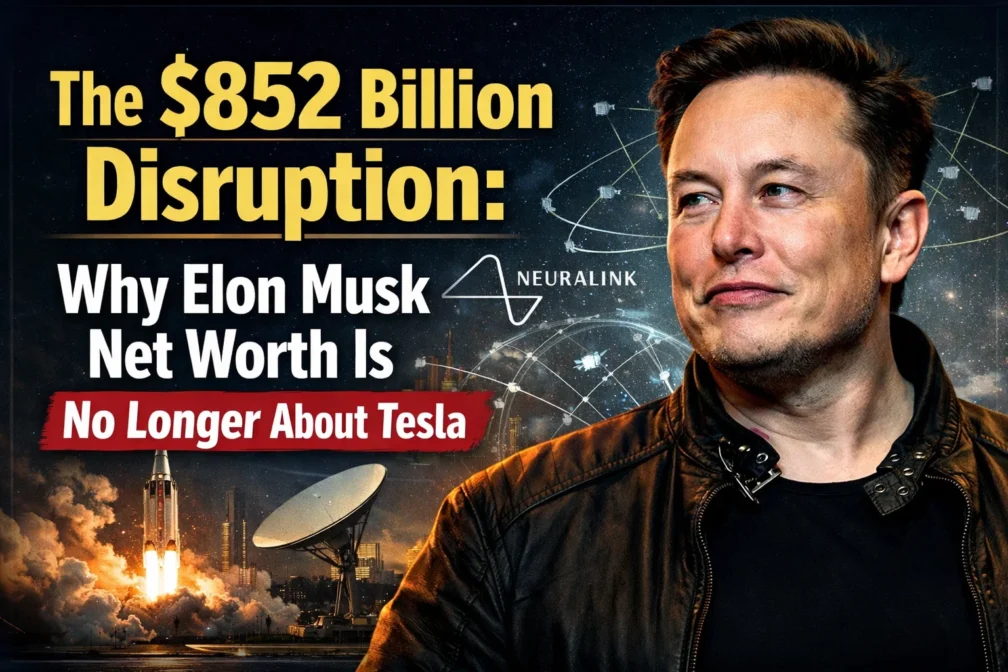

Elon Musk Net Worth;In the winter of 2022, Elon Musk was $200 billion poorer than he had been the previous November. Analysts questioned whether his attention was too fractured. Tesla stock was sliding. Twitter felt like a money pit. Conventional wisdom suggested that no single individual could manage four complex engineering companies simultaneously without seeing their fortune evaporate.
Fast forward to February 2026. Elon Musk net worth has not only recovered—it has detonated past every conceivable ceiling. At $852 billion, according to Forbes, he is now worth more than the bottom 150 countries on earth combined. He sits $578 billion ahead of Larry Page, the world’s second-richest individual .
This is not a story about a rising stock price. It is a story about a fundamental shift in how Musk creates value. For the better part of two decades, Tesla was the engine. Today, that engine is SpaceX. The recent merger with xAI has flipped the center of gravity in his empire, moving it from Palo Alto to Starbase, from batteries to rockets, from electrons to algorithms.
To understand where Elon Musk net worth goes from here—and whether he will become the first trillionaire before the end of this decade—you have to understand why rockets now matter more than roadsters.
The Great Inflection: Why Rockets Overtook Roadsters
For years, the formula was simple: Tesla stock went up, Musk got richer. It was a direct, liquid, observable correlation. As recently as August 2025, Tesla still represented the plurality of his wealth, even as SpaceX gained ground .
That era is over.
The February 2026 merger between SpaceX and xAI did more than consolidate two private companies. It permanently reshuffled the hierarchy of Musk’s holdings. For the first time since 2010, Tesla is no longer the primary driver of Elon Musk net worth .
Consider the math. Pre-merger, Musk’s 42% stake in SpaceX was worth roughly $336 billion. His 49% stake in xAI added another $122 billion. Post-merger, his ownership settled at approximately 43% of a combined entity now valued at $1.25 trillion. That single stake—$542 billion—now accounts for nearly two-thirds of his entire fortune .
Tesla remains enormous by any normal standard. His 12% equity stake is worth roughly $178 billion, plus another $124 billion in options. But it is no longer the sun in this solar system. It is now a very bright planet.
This shift matters because it changes how we forecast Musk’s future wealth. Tesla faces softening demand, BYD’s relentless pressure, and a market that is no longer willing to award it unlimited valuation premiums based solely on hype . SpaceX, by contrast, operates in a category of one.
Deconstructing the SpaceX-xAI Merger: A $1.25 Trillion Thesis
When news broke that SpaceX had acquired xAI, casual observers assumed it was an accounting maneuver—a way to consolidate two assets on a single balance sheet. That interpretation misses the strategic intent.
Musk did not merge these companies to simplify his taxes. He merged them to solve a physics problem.
xAI is voracious for capital. Training frontier models requires clusters of tens of thousands of GPUs, vast data center footprints, and energy consumption rivaling small cities. SpaceX, meanwhile, possesses something no other AI company can easily acquire: the engineering capability to launch massive payloads into low-earth orbit.
The stated goal is to build “orbital data centers.” It sounds like science fiction, but the logic is defensible. Data centers on earth face land constraints, power grid limitations, and regulatory friction. In space, there is unlimited solar energy, near-vacuum cooling, and geopolitical safety. If Musk can manufacture compute infrastructure in orbit, he bypasses every bottleneck currently throttling the AI industry .
This is why the market has assigned the combined entity a $1.25 trillion valuation despite neither company being publicly traded. Investors are not buying a rocket company that dabbles in software. They are buying the only enterprise on earth with a credible path to space-based computing.
For Elon Musk net worth, the implications are staggering. SpaceX’s projected IPO, expected as early as late 2026, could value the company at $1.5 trillion or more . If that occurs, Musk’s stake would exceed $600 billion from that asset alone, even before Tesla contributes another dollar.
The Tesla Paradox: Smaller Share, Bigger Incentives
It would be a mistake to interpret Tesla’s diminished share of Musk’s wealth as evidence that he has lost interest. If anything, the incentives to perform at Tesla have never been higher—they have just become more literal.
In November 2025, shareholders re-approved a new compensation package structured around what the company calls “Mars-shot” goals. If Tesla achieves an eightfold increase in market capitalization and meets specific operational milestones, Musk could receive up to $1 trillion in additional Tesla stock .
This creates a strange dynamic. Tesla now represents a smaller percentage of Elon Musk net worth, yet it holds the key to his trillionaire ambitions.
The first tranche unlocks at a $2 trillion valuation, approximately $460 billion above current levels. To get there, Tesla must execute on two fronts: robotaxis and humanoid robotics. Musk stated in Davos that the robotaxi fleet will be “very, very widespread” across the U.S. by the end of 2026, following its Austin launch in mid-2025 . Optimus, the humanoid robot program, remains earlier stage but carries massive total addressable market assumptions.
Columbia Law professor Dorothy Lund captured the tension succinctly: Tesla designed this package to “prevent him from prioritizing those other ventures.” But Musk now negotiates compensation across multiple companies competing for his attention. It is unclear whether stock grants alone can anchor him to any single organization .
The Wealth Milestone Timeline: From $500 Billion to $852 Billion in Four Months
To appreciate the velocity of this accumulation, consider the following timeline. Musk did not grind his way to $852 billion through decades of compound interest. He essentially added the entire market capitalization of Berkshire Hathaway to his personal balance sheet in less than 120 days.
Elon Musk Net Worth — Recent Milestones
Data compiled from Forbes estimates via Nairametrics, NDTV Profit, and Forbes Luxembourg .
The acceleration is non-linear. It took Musk 14 years to reach his first $100 billion. It then took him 13 months to go from $100 billion to $200 billion. It has now taken him roughly four months to go from $500 billion to $852 billion.
This is not merely wealth creation. It is wealth escape velocity.
The Trillionaire Physics: How Close Is “Close”?
The term “trillionaire” has been used so frequently in headlines that it risks losing meaning. So let us be precise about the math.
To reach $1 trillion in net worth from his current $852 billion, Musk requires an additional $148 billion.
If SpaceX IPOs at a $1.5 trillion valuation and Musk maintains a 40% stake post-dilution, that alone adds roughly $600 billion to his current SpaceX holding—more than enough to cross the threshold . This scenario does not require Tesla to move at all. It does not require xAI to grow further. It does not require the Boring Company or Neuralink to monetize.
The question, therefore, is not whether Musk can become a trillionaire. It is whether SpaceX goes public before the end of 2026.
There are countervailing forces. Public market investors may resist valuing a defense contractor that now includes a capital-intensive AI division competing with Google and OpenAI. SpaceX has received over $20 billion in federal contracts; adding consumer-facing AI scrutiny could complicate that relationship . Regulatory investigations into xAI’s image generator, Grok, remain unresolved in multiple jurisdictions.
But these are headwinds, not walls. If Musk demonstrates that orbital data centers are technically feasible, the valuation narrative shifts entirely. He is no longer selling launches or chatbots. He is selling the industrialization of low-earth orbit.
The Philanthropy Question and Spending Paradox
One of the enduring oddities of Elon Musk net worth is how little it visibly touches his lifestyle. He sold most of his California real estate years ago and reportedly resides in a prefabricated home near the SpaceX Starbase in Texas . He does not own superyachts, private islands, or significant art collections.
The Musk Foundation donates to renewable energy causes, pediatric research, and science education, but its asset base is tiny relative to Musk’s net worth. He has not signed the Giving Pledge. He has not established a large-scale philanthropic vehicle comparable to the Gates Foundation or the Chan Zuckerberg Initiative.
This creates an unusual dynamic. Unlike Warren Buffett or Bill Gates, whose wealth has been statistically capped by their philanthropic distributions, Musk’s net worth operates without that release valve. All appreciation accrues. All dividends reinvest. It is a closed-loop system accumulating at exponential rates.
If and when he becomes a trillionaire, the question will shift from “how did he get there?” to “what does he actually do with it?” Colonizing Mars is not a cheap ambition, but it is also not a $1 trillion ambition—at least not yet.
The Analogy That Explains It All
Imagine three separate oil fields.
The first field, Tesla, is massive and proven. It has been pumping for years. It still produces enormous wealth, but the easy reserves are tapped. Growth requires enhanced recovery techniques—robotaxis, automation, new regulatory regimes.
The second field, SpaceX, was always known to be large, but recent surveys suggest it is actually a superbasin. It stretches far beyond the original drilling coordinates. Every time analysts think they understand its extent, a new discovery pushes the boundary further outward.
The third field, xAI, was a wildcat well that hit pressure unexpectedly. Now it has been connected to the superbasin, and the combined flow rate is unlike anything the industry has ever recorded.
Elon Musk net worth is not the sum of three independent companies. It is the synergistic output of interconnected reservoirs feeding off each other’s pressure. Tesla provides cash and AI inference hardware. SpaceX provides launch capacity and orbital access. xAI provides the intelligence layer that ties them together.
You cannot value this by summing DCF models. You have to value it as an integrated energy system.
Frequently Asked Questions
H3: How much is Elon Musk net worth in February 2026?
As of early February 2026, Forbes estimates Elon Musk’s net worth at approximately $852 billion, making him the wealthiest individual in modern history following the SpaceX-xAI merger .
H3: Did Elon Musk become a trillionaire yet?
No, Elon Musk has not yet reached trillionaire status. His current net worth of $852 billion places him $148 billion away from the $1 trillion threshold. Analysts suggest a SpaceX IPO or Tesla hitting its $2 trillion market cap milestone could close this gap as soon as late 2026 .
H3: What is Elon Musk’s biggest asset now that the merger is complete?
SpaceX is now Musk’s most valuable asset by a significant margin. Following the xAI acquisition, his 43% stake in the combined company is valued at roughly $542 billion, accounting for nearly 64% of his total net worth .
H3: How much Tesla stock does Elon Musk currently own?
Forbes estimates Elon Musk owns approximately 12% of Tesla’s outstanding shares, currently valued at around $178 billion. He also holds Tesla stock options worth an additional $124 billion, though these figures exclude the massive 2025 performance pay package .
H3: Why did Elon Musk’s net worth drop so dramatically in 2022?
Musk made history in 2022 as the first person to lose $200 billion in a single year, primarily due to a sharp decline in Tesla’s stock price amid macroeconomic concerns and his acquisition of Twitter (now X). The recovery began in late 2024 and accelerated dramatically through 2025 and 2026 .
H3: Who is the second richest person in the world?
Larry Page, co-founder of Google, is currently the world’s second-richest person with an estimated net worth of approximately $281 billion. Despite this staggering figure, he sits nearly $580 billion behind Musk—the largest wealth gap between first and second place in history .
Conclusion: The New Wealth Paradigm
There is no playbook for a personal fortune of this magnitude. The last time the world witnessed this level of concentrated wealth, it belonged to oil barons and steel magnates operating in unregulated monopolies. John D. Rockefeller’s peak net worth, adjusted for inflation, sat in the range of $400 billion. Musk is now more than double that.
Yet the nature of the wealth is fundamentally different. Rockefeller controlled physical assets that could be nationalized, regulated, or broken apart. Musk controls multiple capital-intensive, high-technology companies operating in jurisdictions that compete fiercely for his presence. Texas courted him. Delaware lost him. The federal government, despite occasional antitrust murmurs, continues to award SpaceX lucrative contracts.
Elon Musk net worth is no longer a measure of his success as a CEO. It is a measure of the market’s belief that certain technological frontiers—electric autonomy, orbital reuse, general intelligence—are not only viable but imminent. Investors are not betting on Musk the manager. They are betting on Musk the thesis.
That thesis now runs primarily on methane and algorithms, not lithium-ion cells. The shift from Tesla to SpaceX is complete. Whether it carries him to a trillion dollars by 2026 depends on how quickly he can industrialize the vacuum above our atmosphere.
Given his track record, betting against the timeline would be unwise.
This response is AI-generated, for reference only.