
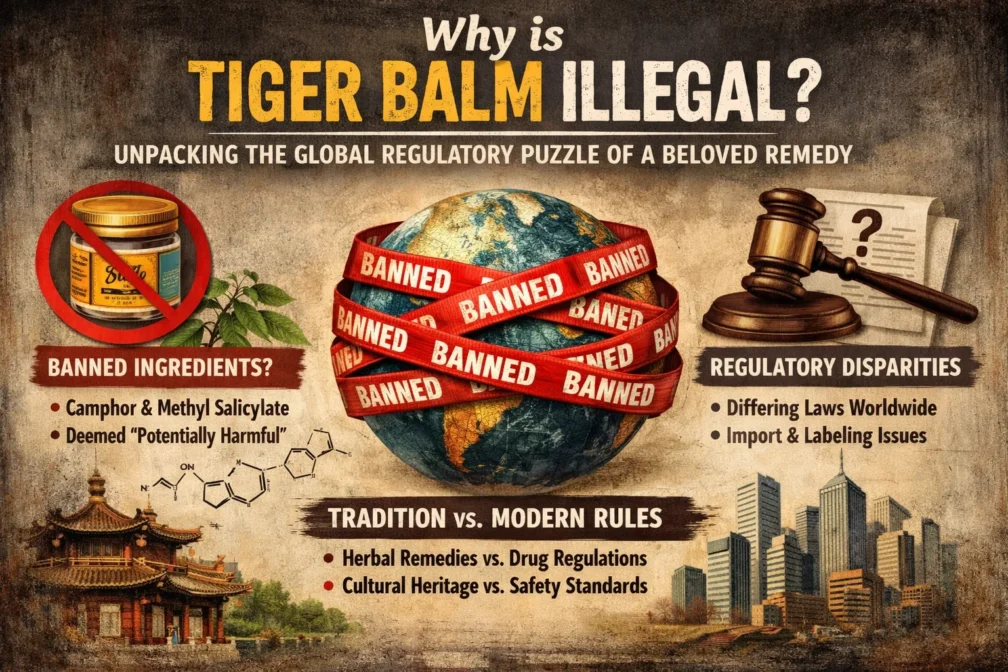

Why is Tiger Balm Illegal; For over a century, Tiger Balm has been a household staple, a familiar red or white ointment synonymous with relief from muscle aches, headaches, and tension. Its potent, camphoraceous scent is instantly recognizable to millions worldwide. Yet, a persistent question circulates online and in travel circles: why is Tiger Balm illegal? The truth is far more nuanced than a simple “yes” or “no.” Tiger Balm is not universally illegal, but its legal status is a patchwork quilt of regulations that vary dramatically from country to country. This complexity stems from its active ingredients,
which are powerful botanical extracts subject to intense scrutiny by health authorities. The core issue isn’t that Tiger Balm is inherently dangerous when used as directed, but that specific components within its formula are controlled substances in certain nations, often due to potential for misuse, toxicity at high doses, or strict legislative frameworks. This article will serve as your definitive guide, dissecting the ingredient-by-ingredient rationale behind regional bans, exploring the fascinating intersection of traditional medicine and modern regulation, and providing clarity on where and why is Tiger Balm illegal to possess or sell.
The Core Ingredients Under the Regulatory Microscope
To understand the global legal stance, we must first examine what gives Tiger Balm its characteristic kick. The classic red ointment primarily relies on three powerhouse ingredients: camphor, menthol, and methyl salicylate. Each is a potent substance in its own right. Camphor, derived from the wood of the camphor tree, is a terpene that stimulates nerve endings, creating a cooling or warming sensation that can distract from pain. Menthol, from mint oils, provides a pronounced cooling effect by activating cold-sensitive receptors in the skin. Methyl salicylate, a compound chemically similar to aspirin, is absorbed through the skin and can provide localized anti-inflammatory and pain-relieving effects.
The therapeutic power of these ingredients is also the source of regulatory concern. In high concentrations or when ingested, they can be toxic. Camphor, in particular, has a narrow therapeutic window—the difference between an effective dose and a harmful one is small. Accidental ingestion, especially by children, can lead to serious neurological symptoms, seizures, or even liver damage. Methyl salicylate, if over-applied over large body areas, can lead to salicylate poisoning, with symptoms resembling aspirin overdose. Therefore, health agencies like the U.S. FDA regulate the maximum allowable concentrations of these ingredients in over-the-counter products, which Tiger Balm formulations generally adhere to in markets where it is legally sold.
A Country-by-Country Breakdown of Legal Status

The legality of Tiger Balm is entirely dependent on the specific drug and cosmetic laws of each sovereign nation. In the United States, Canada, the United Kingdom, and the European Union, Tiger Balm is perfectly legal and widely available as an over-the-counter topical analgesic. Its formulations comply with strict limits on camphor (typically 11% or less) and methyl salicylate. However, the product is often classified as a drug, not a cosmetic, due to its therapeutic claims, meaning it must meet specific labeling and manufacturing standards.
Conversely, in countries like Japan and several within the Middle East, certain Tiger Balm products are prohibited. Japan’s pharmaceutical laws are exceptionally stringent, banning products containing more than a trace amount of methyl salicylate in external analgesics, a rule that directly impacts the classic Tiger Balm formula. In nations like Qatar and the United Arab Emirates, the ban often falls under broader drug control acts that list camphor as a controlled substance, regardless of its concentration in a topical preparation, due to its potential for abuse or misuse. This stark contrast highlights how the same product, with identical ingredients, can be a pharmacy staple in one nation and a confiscated item at customs in another.
| Country/Region | Legal Status | Primary Regulatory Reason & Key Notes |
|---|---|---|
| United States, Canada, EU, UK | Legal & Widely Available | Sold as an OTC topical drug. Formulations comply with limits on camphor (≤11%) and methyl salicylate. |
| Japan | Illegal/Prohibited | Strict laws severely limit methyl salicylate content in external analgesics. Standard Tiger Balm exceeds this limit. |
| U.A.E., Qatar, Saudi Arabia | Illegal/Prohibited | Camphor is often listed as a controlled substance under narcotic/drug control laws, leading to a blanket ban. |
| Australia | Legal (Reformulated) | Original formula was banned. The version sold today is a locally manufactured, compliant formula with different active ingredients (e.g., capsaicin). |
| New Zealand | Legal as a Medicine | Available but classified as a medicine, meaning it can only be sold in pharmacies, not general retailers. |
Camphor: The Primary Culprit in Legal Restrictions
Camphor is, without a doubt, the ingredient most frequently cited when exploring why is Tiger Balm illegal in specific jurisdictions. Its classification is complex. In its pure form, camphor is a white, waxy substance that can be misused as a mild euphoriant or inhalant. While the amount in Tiger Balm is not intended for such use, some countries’ drug schedules do not distinguish between concentrations in medicinal preparations and the pure chemical. This results in a blanket prohibition.
Furthermore, the safety profile of camphor is well-documented. The U.S. FDA mandates child-resistant packaging and prominent warning labels on camphorated products due to risks of ingestion. In regions with less nuanced pharmaceutical regulations, authorities may opt for an outright ban as a precautionary public health measure, especially if there have been historical incidents of misuse or poisoning associated with camphorated oils. This proactive, if broad-brush, approach is a key driver behind the bans.
Methyl Salicylate and the Risk of Salicylate Poisoning
Methyl salicylate, also known as oil of wintergreen, is the second major component that raises regulatory eyebrows. It is a highly concentrated salicylate; just one teaspoon of pure methyl salicylate is equivalent to approximately 7,000 mg of aspirin—a massive and potentially fatal adult dose. The risk with topical products like Tiger Balm is not from casual use, but from over-application. Using too much over large, swathed areas of the body (a practice sometimes called “salicylate wrapping”) can lead to systemic absorption and poisoning.
This real medical risk justifies careful regulation. Authorities in countries like Japan have decided that the risk, however small with proper use, outweighs the benefit for an over-the-counter product, leading to its exclusion. In markets where it is allowed, such as the U.S., labels carry explicit warnings not to use it on large areas of skin or for prolonged periods. This highlights a core theme in the why is Tiger Balm illegal debate: differing national philosophies on risk tolerance and consumer protection.
The Crucial Distinction: “Illegal” vs. “Unapproved” or “Restricted”
In public discourse, the term “illegal” is often used as a catch-all, but in regulatory parlance, distinctions matter immensely. For many consumers wondering why is Tiger Balm illegal, the actual status might be “unapproved” or “restricted.” A product can be unapproved because the manufacturer has not sought or completed the costly regulatory submission process for that specific market, not because its ingredients are explicitly banned. This is a common scenario in smaller markets.
Similarly, a product may be “restricted” rather than outright illegal. It might be available only behind the pharmacy counter (as in New Zealand), require a prescription, or be legal for personal use but not for commercial sale. This nuance is critical for travelers. Possessing a personal-use tube in a country where it’s “unapproved” might simply lead to confiscation at customs, while in a country where camphor is a controlled substance under narcotics laws, it could theoretically lead to more serious legal penalties, though this is exceptionally rare for small quantities.
Historical Context and the Legacy of Traditional Medicines
Tiger Balm’s story begins in the 1870s with herbalist Aw Chu Kin in Rangoon, Burma. Its formulation is rooted in centuries of Chinese herbal medicine traditions, where powerful botanical extracts were commonly used in liniments. When these traditional remedies collided with 20th-century Western-style pharmaceutical regulations, friction was inevitable. Modern drug laws are built on principles of standardized doses, proven efficacy through clinical trials, and clearly documented safety profiles—concepts often at odds with the holistic, experience-based traditions of herbalism.
This historical clash is a subtext to many questions about why is Tiger Balm illegal. Regulatory bodies, tasked with protecting public health, often approach traditional compounds with caution, requiring them to fit into modern classification systems. Some countries have created separate regulatory pathways for traditional medicines, but many have not, forcing products like Tiger Balm to be evaluated as conventional drugs, a process for which they were not originally designed.
The Role of Misuse and Abuse Potential
While the vast majority of users apply Tiger Balm responsibly for muscular aches, regulatory bans are sometimes influenced by the potential for misuse. Camphor, in particular, has a history of recreational misuse. When ingested or inhaled in large quantities, it can cause stimulation, dizziness, and hallucinations. These effects are dangerous and can lead to acute toxicity, but they have contributed to its reputation as an abusable substance.
In regions with significant concerns about substance abuse, lawmakers may cast a wide net, grouping camphor with other controlled volatile substances. As one former drug policy analyst noted, “Regulatory lists aren’t always fine-tuned. Sometimes a substance with any abuse potential, however marginal, gets swept into broad legislation aimed at harder drugs for the sake of administrative simplicity and precaution.” This catch-all approach is another piece of the puzzle explaining why is Tiger Balm illegal in certain places.
Traveler Beware: Customs Confiscations and Personal Use
For globetrotters, the variable legal status of Tiger Balm is a practical concern. Many travelers have stories of having their cherished red jar confiscated at airport security in places like Japan or Middle Eastern hubs. This is the most common real-world manifestation of the ban. Customs officials in these countries are trained to identify the product, and it will be taken away. It is rarely a legal issue beyond the confiscation for personal-use amounts.
The takeaway for travelers is to always research the destination country’s specific regulations on over-the-counter medications. When in doubt, it is far safer to leave Tiger Balm at home and purchase a locally-available alternative at your destination, or use a compliant reformulation. Assuming a product that is ubiquitous at home is legal everywhere is a common and potentially inconvenient mistake, directly stemming from the lack of a global standard on this issue.
Reformulations and Market-Specific Products
In response to these legal hurdles, the brand’s parent company has shown remarkable adaptability. They have created market-specific formulations that comply with local laws. The most famous example is the version sold in Australia. After the original was banned, a new formula was developed for the Australian market, replacing camphor and methyl salicylate with ingredients like capsaicin (from chili peppers) and turpentine oil.
This demonstrates a crucial point: the “Tiger Balm” brand is not monolithic. When consumers ask, “why is Tiger Balm illegal here?” they are often referring to the classic formula. A compliant, legal alternative under the same brand name may be sitting on the shelf next to where the original would be. This strategy allows the company to maintain a global presence while respecting diverse national regulations, though it can cause confusion for consumers who encounter a product with a familiar name but a different sensation and ingredient list.
The FDA’s Stance and OTC Monograph System
In the United States, the FDA’s regulation of Tiger Balm provides a clear example of a risk-based, but permissive, approach. Tiger Balm falls under the FDA’s Over-the-Counter (OTC) Drug Monograph for external analgesics. This monograph is essentially a rulebook that sets conditions—including allowable active ingredients, their maximum concentrations, and required warning labels—under which a product is generally recognized as safe and effective.
Because Tiger Balm’s U.S. formulation adheres to these monographs (e.g., camphor at or below 11%), it is legal. The FDA requires specific warnings on the label: “For external use only,” “Do not use on wounds or damaged skin,” and “Keep out of reach of children.” This system manages the risk through education and controlled access rather than prohibition, representing a different philosophical answer to the same safety concerns that lead other nations to ban it.
Global Harmonization Efforts and Future Outlook
The world is moving, slowly, toward greater harmonization of medical and cosmetic regulations. Bodies like the International Council for Harmonisation of Technical Requirements for Pharmaceuticals for Human Use (ICH) work to align standards. However, topical analgesics like Tiger Balm are a lower priority compared to prescription drugs. National sovereignty over health policy remains paramount, and deeply ingrained cultural attitudes toward traditional and herbal remedies vary widely.
The future of Tiger Balm’s legal status likely involves continued localization. We may see more markets adopting the Australian model of accepting reformulated versions. Increased international travel and e-commerce will keep pressure on authorities to clarify and communicate their rules. However, a single, global standard legalizing the classic formula everywhere is improbable, as the core question of why is Tiger Balm illegal in some places is tied to fundamental, long-standing differences in legal and medical philosophy.
Common Myths and Misconceptions Debunked
A prevalent myth is that Tiger Balm contains illegal narcotics like opium or cannabis. This is entirely false. Its active ingredients are synthetic or distilled plant extracts that are legally controlled in some places but are not narcotics in the classical sense. This rumor may stem from its potent smell and the “Balm” name, which is sometimes associated with psychoactive compounds in historical contexts, or from a simple misunderstanding of customs confiscations.
Another misconception is that if it’s banned, it must be extremely dangerous. In reality, when used exactly as directed on the label, Tiger Balm has a long and well-established safety profile for adults. The bans are primarily precautionary, based on the potential for misuse or accidental poisoning, especially in children, and on rigid legal classifications. Understanding this distinction is key to moving beyond alarmist views of the product’s safety.
Safe Usage Guidelines to Mitigate Risk
Regardless of legal status, safe use is paramount. Always follow the label instructions: use only a small amount on the affected area, no more than 3 to 4 times a day. Never apply it to broken skin, open wounds, or mucous membranes (like the nostrils). It should not be used with a heating pad or tight bandage, as this can dramatically increase absorption and the risk of burns or systemic toxicity.
Crucially, keep it out of reach of children. The appealing smell and accessible jar make it a target for accidental ingestion, which is a medical emergency. If you are pregnant, nursing, have sensitive skin, or are on other medications (especially blood thinners), consult a doctor before use. Adhering to these guidelines addresses the core safety concerns that underpin many regulatory decisions and allows for the beneficial use of the product where it is permitted.
Conclusion: A Matter of Regulation, Not Inherent Danger
The journey to understand why is Tiger Balm illegal in some countries reveals a complex tapestry woven from threads of pharmaceutical law, historical tradition, risk assessment, and national policy. It is not a story of a dangerous product, but of a potent traditional remedy navigating a fragmented modern regulatory landscape. The classic Tiger Balm formula, while safe for most adults when used correctly, contains powerful ingredients that understandably attract scrutiny from public health authorities whose primary mandate is to prevent harm.
Ultimately, its legality is a function of geography and local law, not an absolute statement on its value or safety. In most of the world, it remains a beloved and legal source of relief. Where it is not, reformulations or alternatives exist. For consumers, the key takeaways are awareness and respect: awareness of the rules when traveling, and respect for the power of the ingredients when using the product. The distinctive scent of Tiger Balm will continue to evoke memories of relief for millions, even as its little red jar remains a curious artifact at the intersection of tradition and regulation.
Frequently Asked Questions
Is Tiger Balm illegal in the United States?
No, Tiger Balm is not illegal in the United States. It is legally sold as an over-the-counter topical analgesic in pharmacies, grocery stores, and online. Its formulation complies with U.S. FDA regulations that set maximum limits for ingredients like camphor, which is why you can purchase it freely. The question of why is Tiger Balm illegal primarily applies to other specific countries with different regulatory frameworks.
Can I bring Tiger Balm in my suitcase to Japan?
No, you should not bring classic Tiger Balm to Japan. Japan has strict laws limiting methyl salicylate in topical pain relievers, and standard Tiger Balm formulas exceed this limit. Customs officials are known to confiscate it. To avoid having it taken away, it’s best to leave it at home and seek a locally-approved alternative if needed during your travels.
What ingredient makes Tiger Balm illegal in some places?
The primary ingredients that trigger legal issues are camphor and methyl salicylate. Camphor is often listed as a controlled substance in some Middle Eastern countries due to its potential for misuse. Methyl salicylate is heavily restricted in places like Japan due to its toxicity risk if ingested or misused. The combination and concentration of these are central to understanding why is Tiger Balm illegal in certain jurisdictions.
Is it safe to use Tiger Balm every day?
For occasional, localized pain, daily use as directed on the label is generally considered safe for most adults. However, you should not use it on large areas of your body or under tight bandages daily, as this can lead to dangerous systemic absorption of methyl salicylate. If you find yourself needing it daily for chronic pain, it is advisable to consult a healthcare professional to address the underlying cause.
Are there legal alternatives to Tiger Balm?
Yes, there are many legal alternatives that provide similar topical relief. These include products containing capsaicin, arnica, lidocaine, or other menthol-based creams that comply with local regulations. In countries where the classic Tiger Balm is banned, the brand itself often sells a reformulated, legal version. Always check the active ingredients list to find a product that suits your needs and is approved for sale in your location.