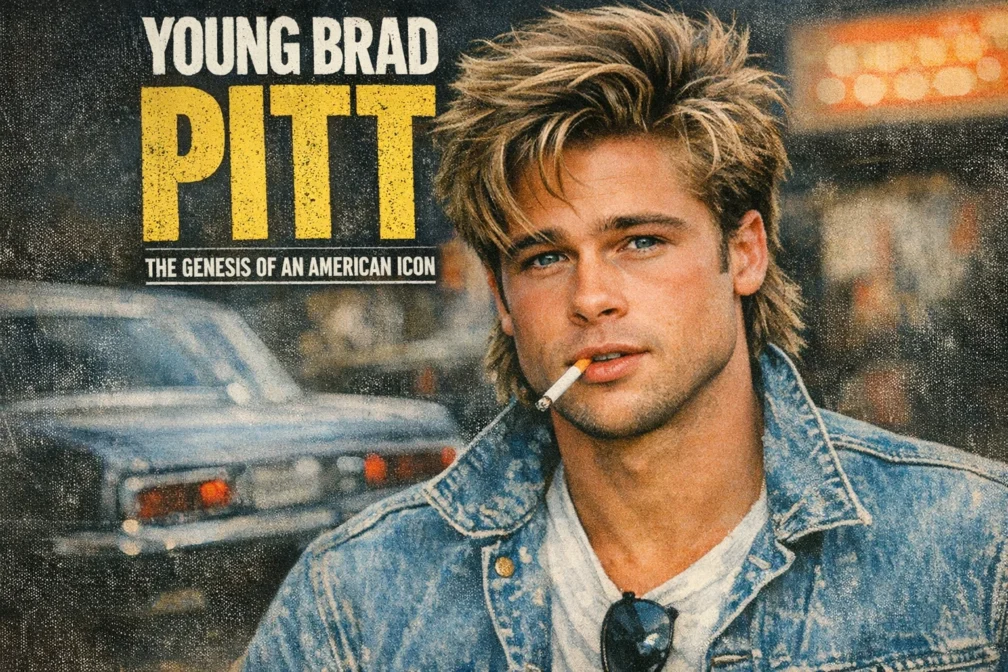

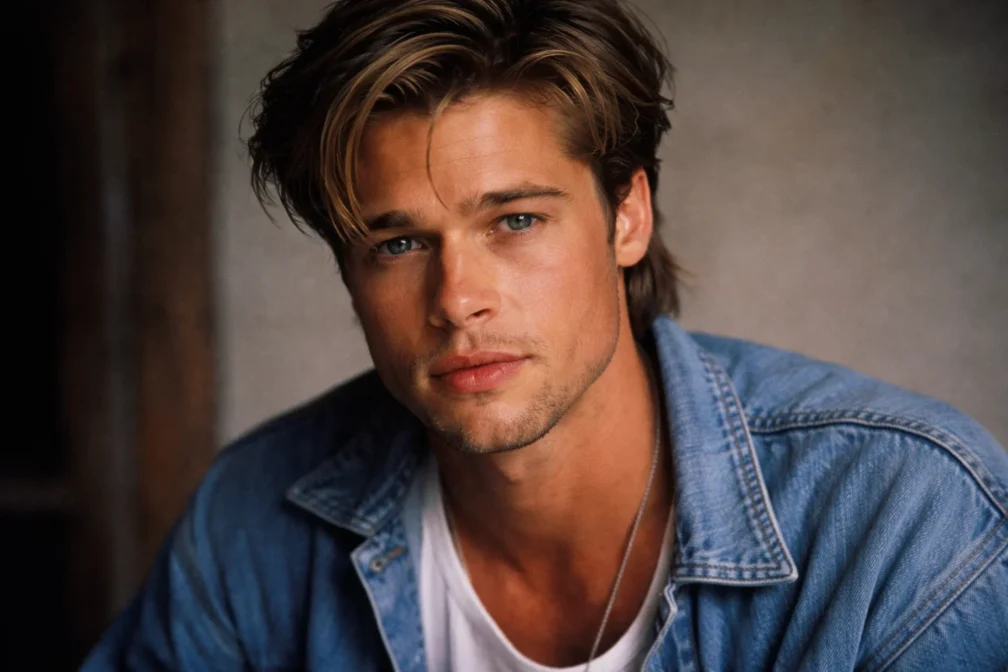
Young Brad Pitt;The image is seared into popular culture: tousled, sun-bleached hair, a jawline that seemed chiseled by classical sculptors, eyes that could flicker from California-casual to intensely focused in a heartbeat. This was young Brad Pitt at the zenith of his arrival, not merely an actor stepping onto the scene, but a phenomenon being born. In the late 1980s and throughout the 1990s,
Pitt didn’t just play characters; he embodied an entire spectrum of youthful American masculinity, ambition, and restless cool. His journey from small-town Missouri to the dizzying heights of Hollywood fame is more than a biography; it’s a masterclass in the alchemy of raw talent, strategic choices, and that ineffable “it” factor.
This exploration delves beyond the magazine covers and red carpet smiles, unpacking the artistic risks, cultural moments, and defining performances that transformed William Bradley Pitt from a promising newcomer into a lasting icon, whose early work continues to resonate with audiences decades later. The era of young Brad Pitt wasn’t just about good looks—it was about the foundation of a career built on surprising depth, a magnetic screen presence, and an audacious willingness to redefine what a leading man could be.
The Missouri Roots and Hollywood Ascent
His origin story adds a crucial layer to the myth. William Bradley Pitt was born in Shawnee, Oklahoma, and raised in Springfield, Missouri, a world away from Hollywood’s glitter. The son of a truck company manager and a school counselor, he was a solid student and a competitive athlete, with dreams of becoming a journalist. Just days before graduating from the University of Missouri with a degree in journalism, he famously packed his Datsun and drove to Los Angeles, fueled by a sudden, irresistible impulse to try acting.
This Midwestern practicality and groundedness became a secret weapon, often overlooked in analyses of his later persona. He wasn’t a industry kid; he was an outsider with an outsider’s work ethic, taking odd jobs—including dressing as a giant chicken for El Pollo Loco—while attending acting classes and chasing auditions.
The early roles were a slow burn, a classic study in persistence. He appeared in uncredited television bits and small parts on shows like Dallas and 21 Jump Street. His first notable film role was a fleeting, wordless appearance as a collegiate partygoer in Less Than Zero (1987). The true turning point arrived on television with a recurring role as the charming, rebellious hitchhiker in the NBC drama A Year in the Life (1987-1988) and a starring role in the poorly received Fox TV movie The Image (1990). However, it was a single scene in a 1990 theatrical release that changed everything.
His brief, electrifying performance as the seductive, doomed hustler in Thelma & Louise (1991), though only about 15 minutes of screen time, detonated in the public consciousness. Dressed in a tank top and a knowing smile, he wasn’t just a character; he was an object of desire and a catalyst for rebellion, announcing the arrival of a major new screen presence. Young Brad Pitt was no longer a secret.
Defining the Early Aesthetic: More Than a Pretty Face
Young Brad Pitt;To reduce the appeal of young Brad Pitt to mere physicality is to miss its cultural engineering entirely. His look at the time—the long, unruly hair in Thelma & Louise and Legends of the Fall, the clean-cut intensity in A River Runs Through It, the sculpted, anarchic physique in Fight Club—was never just aesthetic. It was a direct, visual communication of character ethos. In an era moving away from the rigid, hyper-masculine archetypes of the 80s, Pitt’s beauty was accessible, almost tousled. It suggested a sensitivity and a wildness coexisting, a departure from the untouchable action heroes of the previous decade. This made him relatable to a wide audience; he was the dreamy boyfriend, the rebellious brother, and the philosophical drifter all at once, a versatility that magazine editors and casting directors quickly recognized as box office gold.
This aesthetic, however, was always in service of something more substantive. Pitt, even in his earliest interviews, displayed a sharp, self-aware intelligence and a distinct lack of vanity about his looks. He famously referred to himself as just “some kid with his shirt off” post-Thelma & Louise. This dichotomy—possessing staggering beauty while seemingly dismissing its importance—only amplified his allure. It allowed audiences and critics to take him more seriously as he pursued complex roles. The aesthetic was the hook, but the performances he chose demonstrated a clear desire to be more than a matinee idol. He leveraged his looks to gain entry, then consistently worked to subvert the very expectations they created, building a fascinating tension that defined his early career trajectory.
The Breakthrough Trinity: Thelma & Louise, A River Runs Through It, and Legends of the Fall
Young Brad Pitt;The three-year period from 1991 to 1994 represents the core founding trilogy of Pitt’s stardom, a sequence of roles that showcased astonishing range and established his core archetypes. Thelma & Louise provided the explosive, mythic introduction. As J.D., he was pure id and charm, a fantasy figure who catalyzes the protagonists’ liberation. His performance was a masterclass in minimalist seduction, proving he could command a film with sheer presence alone. Immediately following this, he pivoted drastically to the soulful, disciplined Norman Maclean in Robert Redford’s A River Runs Through It (1992). Here, young Brad Pitt channeled a poetic, internalized masculinity. His connection with nature, his quiet yearning, and his nuanced portrayal of a man bound by family and landscape showcased a dramatic depth that silenced any doubters.
He then completed this foundational arc with the epic, tragic romance of Legends of the Fall (1994). As Tristan Ludlow, Pitt fully embraced the “brooding heartthrob” archetype, but infused it with a raw, animalistic pain. Tristan was a force of nature—wounded, passionate, and forever restless. The role synthesized his physical dynamism with deep emotional turmoil, making him the definitive romantic lead of the decade. This trinity—the hustler, the poet, and the warrior—created a composite portrait of an actor who refused to be pinned down. He wasn’t building a brand of a single type; he was demonstrating a portfolio of possibilities, each performance expanding the boundaries of what audiences could expect from him. This strategic variance prevented typecasting and laid the groundwork for the even riskier choices to come.
The Strategic Pivot: Embracing the Character Actor Within
By the mid-90s, with leading man status firmly secured, Pitt embarked on a conscious, daring mission to dismantle his own pin-up image. This wasn’t a rejection of stardom, but a redefinition of it on his own terms. He began gravitating toward roles that were eccentric, morally ambiguous, and often physically transformed. In 12 Monkeys (1995), his Oscar-nominated turn as the twitchy, mentally fractured Jeffrey Goines was a revelation. With wild hair, jerky movements, and a frantic energy, he disappeared into the role, proving his commitment to craft over image. This was followed by the sinister, frosty intensity of Detective David Mills in Se7en (1995), a performance that balanced everyman decency with a horrifying crescendo of rage.
The culmination of this pivot was his portrayal of the Irish Traveller boxer, Mickey O’Neil, in Guy Ritchie’s Snatch (2000). With an impenetrable accent, a kinetic physicality, and a mischievous glint in his eye, Pitt stole the film from a packed ensemble. He was virtually unrecognizable, yet utterly magnetic. This phase was crucial. It signaled to the industry and audiences alike that young Brad Pitt was an actor first and a movie star second. He was willing to be ugly, strange, and unsettling if it served the story. These choices built immense credibility, granting him the artistic license to headline major studio films while also pursuing passion projects, a balance he has maintained throughout his career. It was the strategic dismantling of the “pretty boy” that ensured his longevity.
The Counterculture Catalyst: Fight Club and a Generation’s Discontent
No analysis of young Brad Pitt is complete without the seismic cultural impact of Fight Club (1999). As Tyler Durden, Pitt didn’t just play a character; he became the anarchic, charismatic id of a generation of disaffected young men. With his slicked-back hair, muscular decay, and nihilistic philosophy, Tyler was the ultimate antithesis to the consumerist, emasculated “Ikea nesting” lifestyle. Pitt’s performance was a carefully calibrated cocktail of menace, charm, and persuasive logic. He made chaos and destruction feel liberating and, for many, dangerously attractive. The role cemented his status as more than a Hollywood star; he was a cultural commentator, channeling the latent frustrations of the pre-millennial era.
The film’s legacy is complex, often misunderstood, and perennially controversial, which only adds to the power of Pitt’s performance. He managed to make Tyler both a magnetic leader and a terrifying warning. The physical transformation—lean, bruised, and buzzing with manic energy—was total. This role represented the final, explosive shedding of any remaining conventional leading man skin. After Tyler Durden, Pitt could never be viewed as just a romantic hero again. He had irrevocably linked his image to complex, challenging, and ideologically loaded material. It was a career-defining risk that paid off in everlasting relevance, ensuring the era of young Brad Pitt would be studied not just for its films, but for its profound impact on the cultural conversation.
The Collaborator: Formative Partnerships with Directors
A key driver of Pitt’s artistic evolution was his keen eye for collaborating with visionary, often auteurist, directors. Even as a rising star, he showed a propensity for seeking out filmmakers with distinct voices rather than just commercial pedigree. His partnership with Robert Redford on A River Runs Through It was a master-student dynamic that taught him subtlety and restraint. Terry Gilliam (12 Monkeys) pushed him into the realm of the bizarre and theatrical, unlocking a frenetic energy. David Fincher became perhaps his most significant early collaborator, directing him in Se7en, Fight Club, and later The Curious Case of Benjamin Button. Fincher’s perfectionism and dark, stylish vision perfectly complemented Pitt’s own growing ambition for substantive, meticulously crafted projects.
Furthermore, his work with Anthony Minghella (The English Patient, in a supporting role), Alan J. Pakula (The Devil’s Own), and the Coen Brothers (Burn After Reading) demonstrates a consistent pattern of using his star power to enable interesting work with top-tier directors. These relationships were not passive; Pitt, through his production company Plan B Entertainment (established in 2001), actively began shaping projects. This transition from actor-for-hire to creative producer began in the latter stages of his “young” period, showcasing a strategic mind interested in the architecture of cinema itself. These collaborations provided the scaffolding upon which young Brad Pitt built his reputation as a serious, thoughtful artist, not just a passenger in his career but a pilot seeking out turbulent and rewarding creative weather.
The Style and Substance of an Era’s Leading Man
Pitt’s influence extended far beyond the screen, dictating male fashion and grooming trends throughout the 90s. His looks became blueprints for a generation. The sleeveless tank top and jeans from Thelma & Louise, the crisp suits and slicked-back hair of Ocean’s Eleven, the rugged, layered frontier wear of Legends of the Fall, and the minimalist, deconstructed suits he wore on red carpets—each spawned imitations worldwide. He made long hair look masculine again, then made a clean-shaven, tailored look feel modern. This sartorial impact was inseparable from his characters; the clothing felt like an extension of their attitudes, making the style aspirational because it was tied to a persona.
Yet, crucially, this style never felt like empty posturing. It was always anchored by the substance of his performances and his off-screen demeanor. In interviews, he was famously low-key, self-deprecating, and focused on the work, avoiding the flashy trappings of fame. This created a powerful authenticity loop: the compelling characters made the style desirable, and his genuine, no-nonsense personality made it feel attainable. He represented a new kind of male celebrity—one who could be both an object of desire and a relatable, almost regular guy. This balance between aspirational glamour and grounded authenticity is a hallmark of the young Brad Pitt phenomenon and a key reason his appeal has proven so durable across decades.
The Evolution of an Acting Methodology
While not a practitioner of a single, formalized acting school, Pitt’s early work reveals a clear and evolving methodology centered on physical transformation and intense observation. He has often spoken about building characters from the outside in, using costumes, accents, and physicality as a gateway to their psychology. For 12 Monkeys, he spent time in a psychiatric ward. For Fight Club, he trained in multiple martial arts and took lessons in soap making and leatherworking to understand Tyler’s manual skills. For Snatch, he lived and trained with real Irish Travellers to master the accent and physicality. This commitment to immersive detail moved him beyond simply delivering lines to fully inhabiting a character’s world.
This approach also protected him. By focusing intensely on the technical and observational aspects of a role, he could shield himself from the overwhelming scrutiny of his own fame. It was a way to disappear. As he matured, this methodology evolved into a more relaxed, instinctual style, but its roots are clearly visible in the dedicated, research-heavy preparations of his early career. It underscores a fundamental truth: the seeming effortlessness of young Brad Pitt on screen was, in fact, the product of considerable effort, a disciplined work ethic that transformed natural charisma into consistent, credible artistry.
Box Office Appeal and Critical Acclaim: The Dual Track
One of the defining features of Pitt’s early career was his ability to navigate a dual track: achieving massive commercial success while simultaneously earning critical respect. This is a rare and difficult balance in Hollywood. He headlined major studio blockbusters like Interview with the Vampire (1994) and Ocean’s Eleven (2001), films that were unequivocally popular and glamorous. Yet, in the very same periods, he was delivering Oscar-nominated work in 12 Monkeys and starring in challenging auteur-driven films like Fight Club, which was a critical flashpoint and a commercial disappointment initially, only to become a cult classic.
The table below illustrates this deliberate dual-path strategy during his formative years:
| Film (Year) | Role Type / Genre | Box Office / Commercial | Critical / Awards Reception | Strategic Purpose |
|---|---|---|---|---|
| Interview with the Vampire (1994) | Gothic Horror / Supernatural Lead | Major Hit ($223M worldwide) | Mixed reviews; praised for visuals & cast | Leveraged star power in a major franchise; expanded fanbase. |
| 12 Monkeys (1995) | Sci-Fi / Character Actor Lead | Solid Success ($168M worldwide) | Oscar Nomination; Critical acclaim for performance | Proved dramatic depth; earned industry credibility. |
| Seven (1995) | Thriller / Ensemble Lead | Breakout Hit ($327M worldwide) | Major critical praise; cultural phenomenon | Balanced dark material with mainstream appeal; Fincher partnership. |
| The Devil’s Own (1997) | Action Thriller / Star Vehicle | Moderate Success ($140M worldwide) | Largely negative reviews | Conventional star role; highlighted risks of generic choices. |
| Fight Club (1999) | Drama / Antihero Lead | Initial Flop ($101M worldwide) | Critically divisive; later cult classic & critical re-evaluation | Ultimate artistic risk; cemented iconic, rebellious status. |
| Ocean’s Eleven (2001) | Heist / Ensemble Star | Blockbuster ($450M worldwide) | Strong reviews for fun, style, and cast chemistry | Re-established A-list commercial clout with cool, crowd-pleasing role. |
This table shows a clear pattern of alternating between safe, star-vehicle projects and risky, artistically ambitious ones. This strategy allowed him to finance his credibility with his commercial success, and vice-versa, ensuring his longevity and relevance in an industry that often forces actors to choose one lane.
The Personal Life Magnifying Glass
The ascent of young Brad Pitt occurred in tandem with the explosive growth of tabloid journalism and celebrity culture in the 1990s. His high-profile relationships—particularly his marriage to Jennifer Aniston in 2000—catapulted him into a stratosphere of fame where his personal life often overshadowed his professional work. The “Brad and Jen” phenomenon created a media frenzy unlike any before, framing him as the prince of a Hollywood fairy tale. This intense scrutiny was a double-edged sword. It amplified his global recognition to unimaginable levels, making him a household name far beyond cinema audiences. Every haircut, every casual outfit, every public appearance became news.
However, this magnifying glass also posed a significant challenge to his artistic ambitions. It threatened to reduce his complex career to gossip fodder and simplistic narrative arcs. Pitt often expressed frustration with this, wanting the work to speak for itself. Yet, he also navigated it with a degree of grace and privacy that maintained an air of mystery. He rarely engaged in public feuds or over-shared, which allowed the public to eventually re-engage with him as an actor and producer, separate from the tabloid storylines. This period was a crucial trial by fire, teaching him how to manage the gargantuan scale of his fame while protecting the creative core of his career.
The Bridge to Maturity: From Young Star to Industry Pillar
The turn of the millennium marked a natural transition from the young Brad Pitt era to his establishment as a multifaceted industry pillar. Key projects served as bridges. Ocean’s Eleven (2001) showcased a more relaxed, mature, and effortlessly cool version of his star power—the leader of a gang, not the lone rebel. Troy (2004) saw him step into the classic epic hero role, albeit with a nuanced weariness. More importantly, the founding of Plan B Entertainment in 2001 was the definitive signal of his evolution. His role as a producer for films like The Departed (2006), 12 Years a Slave (2013), and Moonlight (2016) demonstrated a sophisticated understanding of storytelling and a commitment to elevating important voices, ultimately earning him Oscar wins for Best Picture.
This transition was seamless because it was built on the foundation of his early choices. The credibility earned from 12 Monkeys and Fight Club gave him the leverage to become a producer. The commercial capital from Ocean’s and Interview with a Vampire gave him the financial means. The young Brad Pitt had been ambitious not just for fame, but for creative control and lasting impact. The adult Brad Pitt simply realized that ambition, transitioning from being a face in front of the camera to a force behind it, all while continuing to deliver acclaimed performances in films like The Assassination of Jesse James by the Coward Robert Ford (2007) and Once Upon a Time in Hollywood (2019).
The Enduring Legacy of the Early Years
The legacy of young Brad Pitt is not frozen in the 1990s; it actively informs cinema and stardom today. He redefined the template for the modern leading man by proving that audiences would follow an actor into weird, dark, and challenging territory if the performance was compelling enough. He demonstrated that physical appeal and serious acting chops are not mutually exclusive, but can be powerfully synergistic. His career path became a model for the next generation of actors—think Robert Pattinson or Timothée Chalamet—who consciously mix blockbuster franchises with indie darlings and seek auteur collaborations.
Furthermore, the specific characters he portrayed continue to resonate. Tyler Durden remains a flawed, problematic but endlessly analyzed touchstone for discussions on masculinity. Tristan Ludlow is still the benchmark for the brooding historical romantic lead. His early work is a masterclass in strategic career building, showing how to use one’s initial assets to buy the creative freedom to do more interesting work. The image of young Brad Pitt—that perfect amalgam of rebellion, sensitivity, and ambition—is permanently etched into our cultural memory, not as a relic, but as a living blueprint for how to build a lasting and meaningful career in the spotlight.
As film critic Owen Gleiberman once reflected on Pitt’s unique position, “He possessed the aura of a classic movie star from the moment he appeared on screen, but he always seemed to be thinking his way through it, using his looks as a tool rather than a crutch. That intellectual curiosity beneath the surface is what turned him from a sensation into an institution.” This captures the essence of the journey perfectly.
Conclusion
The story of young Brad Pitt is a multifaceted study in the construction of a lasting icon. It began with undeniable genetic fortune, yes, but was swiftly and deliberately forged through a series of bold, intelligent choices. From the explosive introduction in Thelma & Louise to the poetic restraint of A River Runs Through It, from the unhinged brilliance of 12 Monkeys to the cultural atom bomb of Fight Club, Pitt consistently used his platform not to repeat himself, but to reinvent and challenge.
He mastered the delicate dance between commercial appeal and critical credibility, between heartthrob status and character actor obscurity. He allowed the world to project its fantasies onto him, all while working diligently behind the scenes to ensure he had the craft to back up the hype. The young Brad Pitt era was not a period of simple celebrity; it was the foundational chapter of a profound cinematic legacy, proving that in Hollywood, the most powerful thing a star can be is smart, strategic, and unafraid to get messy. His early career remains the ultimate playbook for transforming potential into permanence.
Frequently Asked Questions
What was young Brad Pitt’s first major movie role?
While he had small television and film parts earlier, young Brad Pitt‘s first major, attention-grabbing role was as the charming drifter J.D. in Ridley Scott’s Thelma & Louise (1991). Though his screen time was limited, his performance became an instant cultural sensation and is widely credited as his true breakthrough, catapulting him into the Hollywood spotlight and defining his initial “rebellious heartthrob” persona.
How did Brad Pitt avoid being typecast as just a pretty face early on?
He made a conscious and strategic pivot immediately after his heartthrob status was secured. Young Brad Pitt actively sought roles that were eccentric, physically transformative, and morally complex, such as the mentally unstable Jeffrey Goines in 12 Monkeys (1995) and the incomprehensible boxer Mickey in Snatch (2000). By embracing his inner character actor, he demonstrated serious dramatic range and commitment to craft, forcing critics and audiences to look beyond his looks.
What is considered Brad Pitt’s best performance from his early career?
This is subjective, but two performances consistently top critical lists. His Oscar-nominated, frenetic turn in 12 Monkeys is hailed as a masterpiece of character acting. Conversely, his iconic, generation-defining role as the anarchic Tyler Durden in Fight Club (1999) is considered his most culturally impactful work. Both showcase the duality of young Brad Pitt: the dedicated technical actor and the magnetic, archetypal movie star.
Did young Brad Pitt do his own fight scenes in movies?
Yes, Pitt was known for a high level of physical commitment in his early roles. For Fight Club, he underwent extensive training in multiple disciplines including boxing, taekwondo, and grappling to perform the raw, brutal fight sequences alongside Edward Norton. This dedication to authenticity was a hallmark of his immersive approach to building characters from the outside in.
How did Brad Pitt’s style in the 90s influence fashion?
Young Brad Pitt was a definitive male fashion icon of the 1990s. His looks in films directly translated into global trends: the sleeveless tank top and jeans from Thelma & Louise, the rugged, layered frontier wear from Legends of the Fall, and the sleek, minimalist suits from red carpets and Ocean’s Eleven. He made long hair and goatees mainstream and exemplified a casual, effortless cool that moved men’s fashion away from the opulent 80s toward a more relaxed, authentic aesthetic.